Recreating Historically Significant Public Spaces

Image
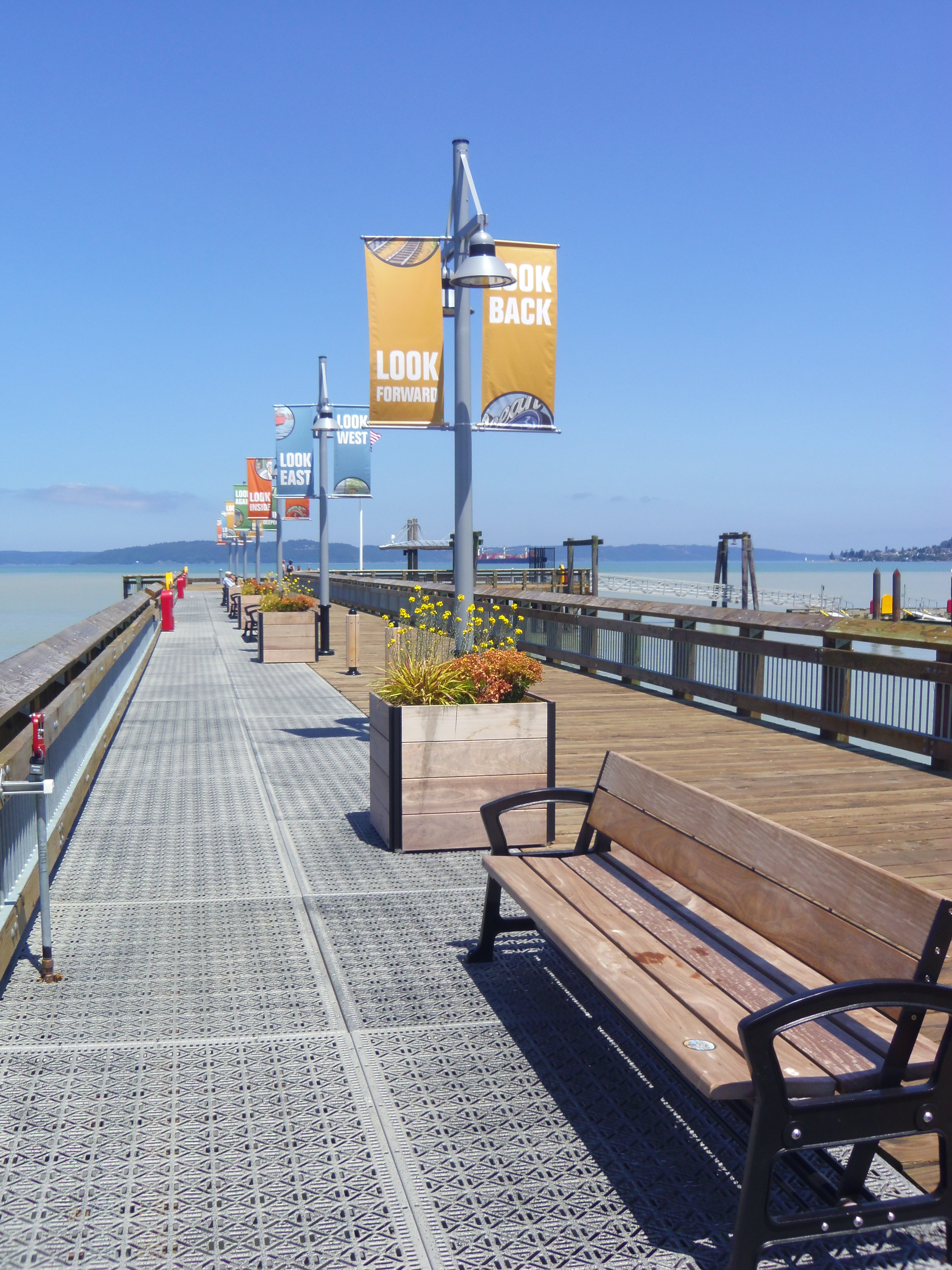
Old Town Dock after Re-creation
Image
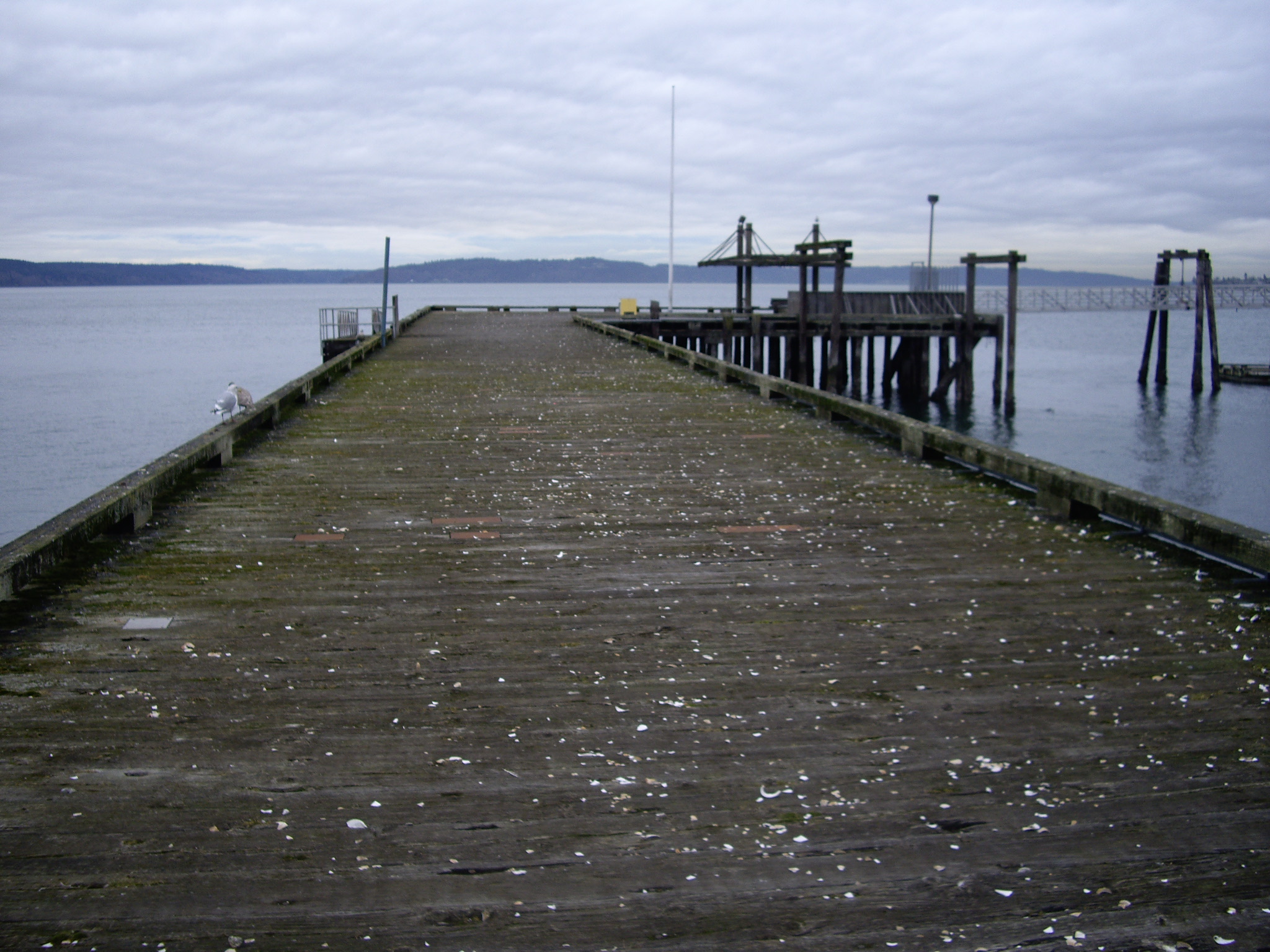
Before restoration, the dock was unsafe and closed to the public.

by Mike Perfetti

Public parks and outdoor civic spaces provide many day-to-day and long-term civic and environmental functions.  Park creation and re-creation require coordination and collaboration between designers and stakeholders in order to create a design that reflects the desires, trends, and economics of a community at a specific point in time.  As well, the design must respect the past while responding to perceived environmental factors.  Communities inevitably change and as time grinds away we are tasked with recreating the place.  If we do it right, the place will be renewed and become beloved in new ways.

Understanding and Appreciating the Past

Many parks are rich with histories treasured by their communities.  These stories are vital to a community’s identity.

Like buildings, outdoor public spaces can be historic, and are often guarded by the people who love them.  For landscape architects, it’s important to engage with the community and project stakeholders and to demonstrate an understanding and appreciation of the past.  We must also demonstrate the ability to implement changes that preserve, and ideally, enrich that history.

What are some of today’s cultural trends and environmental factors that affect parks?  There are many.  Some examples include

  • The popularity of dog-ownership
  • Urban Densification
  • Cultural diversity
  • Sea level rise

Old Town Dock

Image
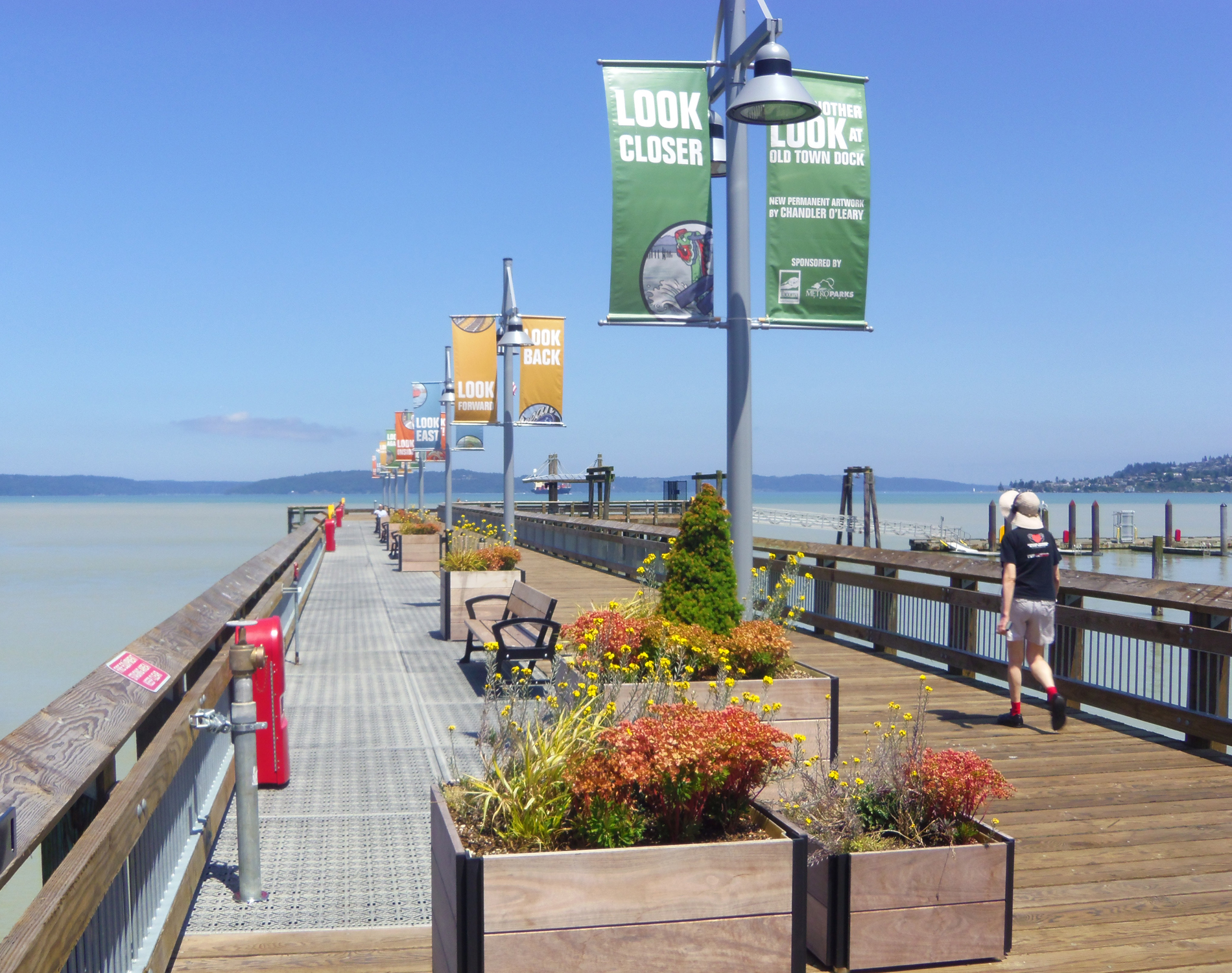
Old Town Dock reopened to the public in May.

J.A. Brennan Associates has worked on several projects recently that featured the redesign of historically significant civic spaces.  One project is Tacoma’s Old Town Dock.  Located on the shores of Commencement Bay, the dock is an important place where people of the historic Old Town neighborhood connect with the water.  Old Town was once a fishing village, which eventually grew into part of Tacoma’s industrial waterfront.  Old Town Dock was built in 1873 and served the shipping industry until operations moved.  The dock fell into disrepair, was condemned, then rebuilt in 1953 and opened to public use with the additions of railings, benches, lighting, a restroom, shelter, and artificial reef.  As Tacoma’s Ruston Way waterfront was changing from industrial use to recreational use, the dock became a popular public space, but was closed in 2008 after it was determined to be unsafe.

Working with Owners and Stakeholders

The City hired Reid Middleton, with J.A. Brennan, to design the dock renovation and restore the vital public space.  The design team worked closely with the Old Town Dock Citizen Advisory Group to understand the history of the dock and the Old Town Neighborhood.  We incorporated many of the advisory group’s recommendations within the context of the Ruston Way waterfront, while accommodating the City’s project budget.

The advisory group sought to recall the character of the older dock and relate to its setting in the Old Town neighborhood.  The group wanted to provide day-use moorage and launching for human-powered watercraft, opportunities for water access and enjoyment, and strengthen the connection between the dock and Old Town.
Image

Re-creation

The re-created dock maintains its original footprint.  For the design of the dock, floats, and upland area, we tried to achieve the advisory group’s goals through the selection of appropriate materials, namely wood on the dock, and brick onshore.  Both materials relate the character of the dock and neighborhood.  Double mast-arm lights, designed by Harbor Power Engineering in collaboration with J.A. Brennan, recall the old wharf’s design standards.

The old wood decking was generally in disrepair but some wood was in good condition, allowing for adaptive reuse.  This salvaged wood was laid in a distinctive pattern beneath the viewing pavilion.  Originally a wood-shingled roof structure, the pavilion was restored with a standing-seam metal roof and rebuilt to recall the original pavilion.
Image
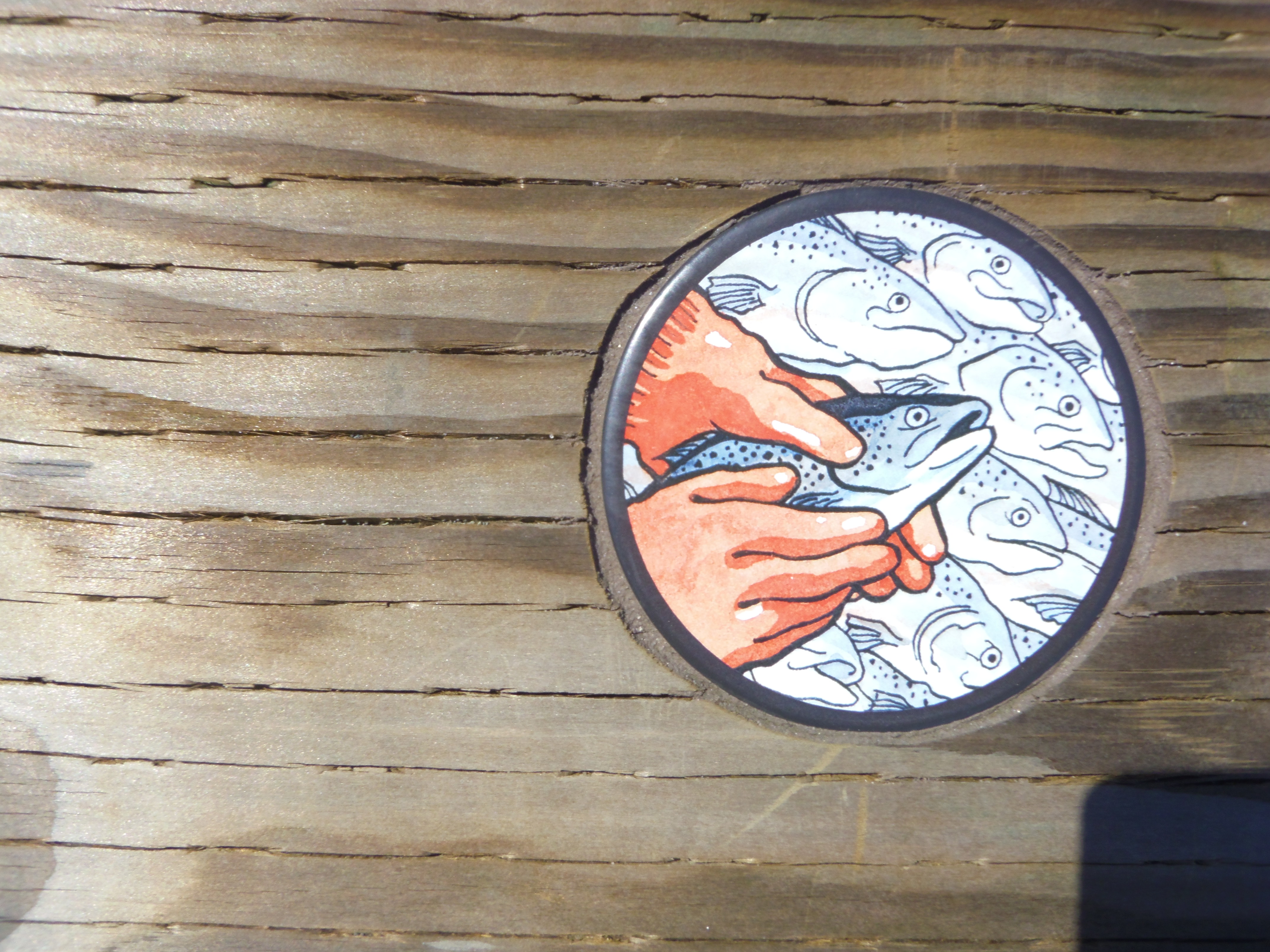
“Droplets” — a series of 9″ to 12” circular porcelain enamel art installations, by Chandler O’ Leary — are dispersed throughout the site and depict past and present scenes of Tacoma’s waterfront. The installation adds intrigue and contributes to the sense of place, providing dock visitors with a subtle and beautiful journey through time.

The dock was renovated and reopened May 15, 2013.  The design process was a successful collaboration between designer and stakeholders, and the outcome reflects the needs of the community while enhancing the historic character of the place.  Since its opening, Old Town Dock has been a smashing hit in Tacoma’s Old Town neighborhood, defining public space, expressing its history, and drawing people to the water.
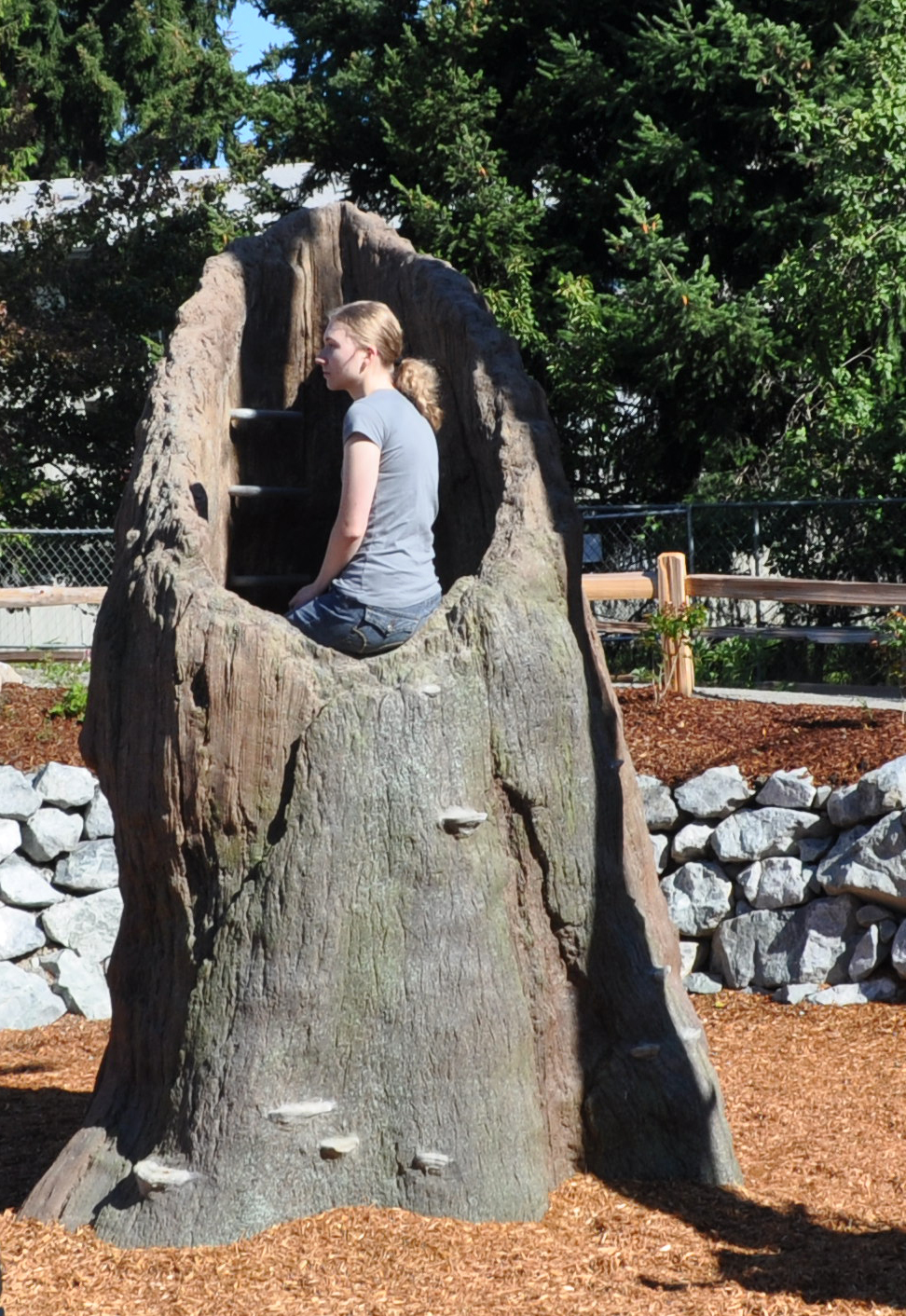
Nature Play

TNC_snag_DSC_0134
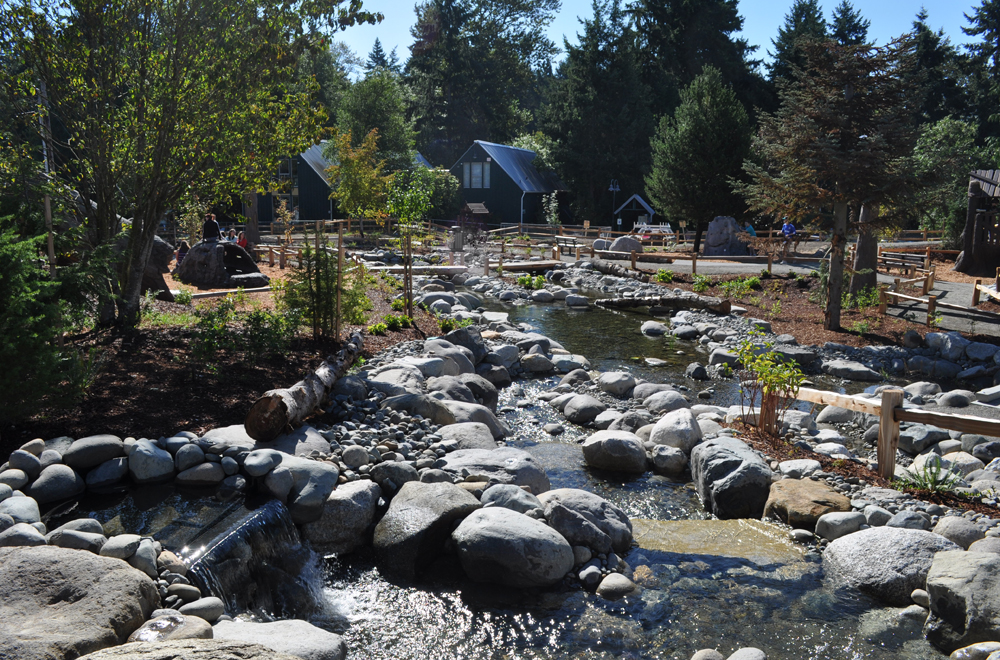
Custom designed climbing/play snag at Discovery Pond, Tacoma Nature Center, Tacoma, WA

Recently Mike Perfetti, senior associate, presented at the Washington Recreation & Park Association’s (WRPA) Annual Conference & Trade Show, held this year in Vancouver, WA.  WRPA’s mission is to promote excellence of current and future Parks and Recreation professionals through advocacy, education, networking, and training.

Mike’s presentation, Nature-based Playgrounds: From Design to Operation, provided insight for park managers, staff, and students interested in implementing nature play opportunities in public parks.

Background
Today there is substantial amount of awareness and supporting research regarding the unhealthy state of many American children.  Since the release of Richard Louv’s best-selling book, Last Child in the Woods: Saving Our Children from Nature-Deficit Disorder (Algonquin Books of Chapel Hill, 2005), it has become a priority among parents and park managers to help children play safely outdoors and, at the same time, benefit from the teachings of the natural world.

In his book, Louv cites the well-known obesity epidemic among American children today and the lack of exposure to the natural world, which he posits inhibits nature appreciation, understanding, and survival skills, as well as physical conditioning.  He believes this lack of exposure to the outdoors has to do with parents’ and guardians’ real and perceived fears, as well as a high level of exposure to time-consuming pursuits of gaming and video watching.

Mike’s presentation advocates for the implementation of nature-based play opportunities within public spaces.  Mike describes two nature play models:

 Model 1: The Informal Free Play Model

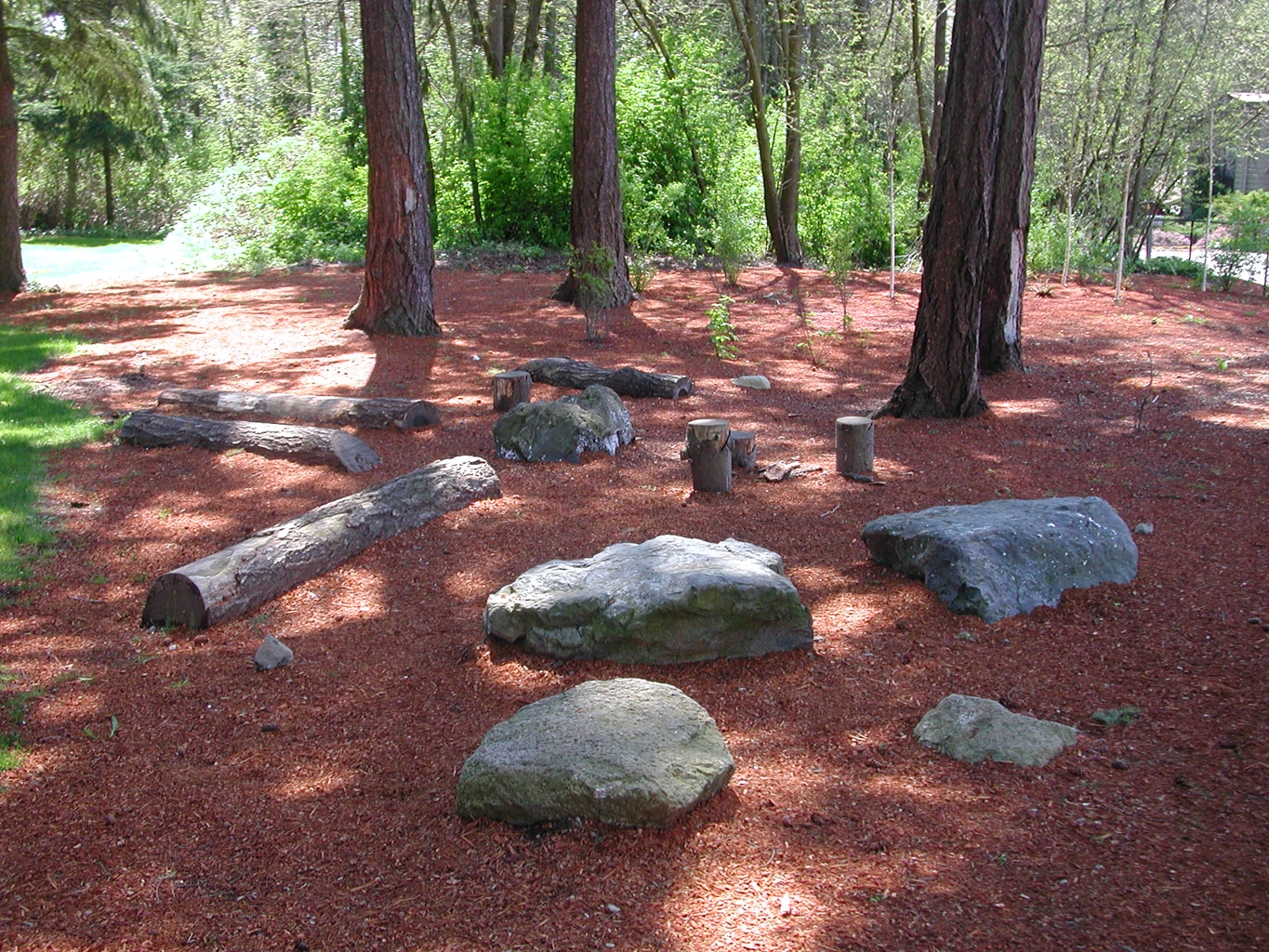
Mathison Park nature play features in Burien, WA

In this model, nature play takes place on a piece of public land set aside for that purpose, or within which it is an allowed use, but the amount of introduced play components is kept to a minimum.  This model represents nature play at its core, allowing children to play in an essentially undeveloped, naturalistic environment, and is also beneficial in terms of being inexpensive to implement.

Model 2: The Fabricated Nature Play Model

house
Tree house structure at Discovery Pond, Tacoma Nature Center

The fabricated nature play model relies on introducing fabricated play components into an area, which provide some degree of nature-oriented play and/or learning.  This is useful in a number of applications, such as sites that lack significant natural components, or where maintenance, liability or supervision may be issues.  This can be a particularly effective model in terms of appealing to a great number of people, and can be adapted to a wide variety of sites and conditions.

Case Study

TNC_Overview_DSC_0107
Discovery Pond at the Tacoma Nature Center

Mike presented J.A. Brennan’s design for the Discovery Pond Nature-based Playground at the Tacoma Nature Center as the major case study in understanding how to implement nature-based play in a park.  He highlighted the need for outlining a program with goals and objectives and listening to stakeholder input as key components to creating a successful nature play area.

Discovery Pond is centered around a recirculating water feature and features an array of fabricated natural-looking play elements that serve children of all ages and is ADA accessible.  The design carefully restores the site and creates a natural appearance that complements the Nature Center’s site and programming.

Here comes the water!

Engineering: Tetra Tech Inc.
Landscape Architecture: J.A. Brennan

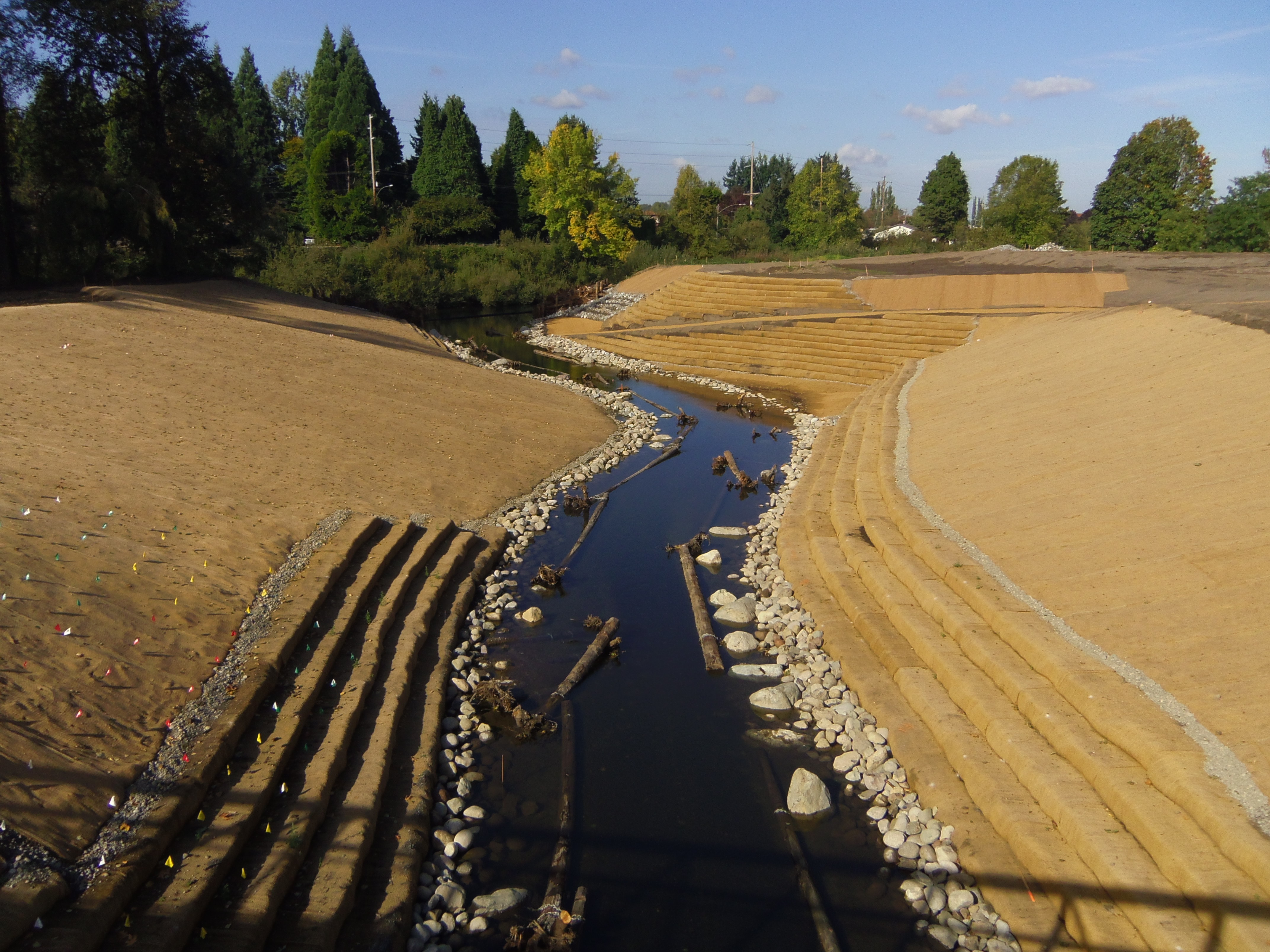
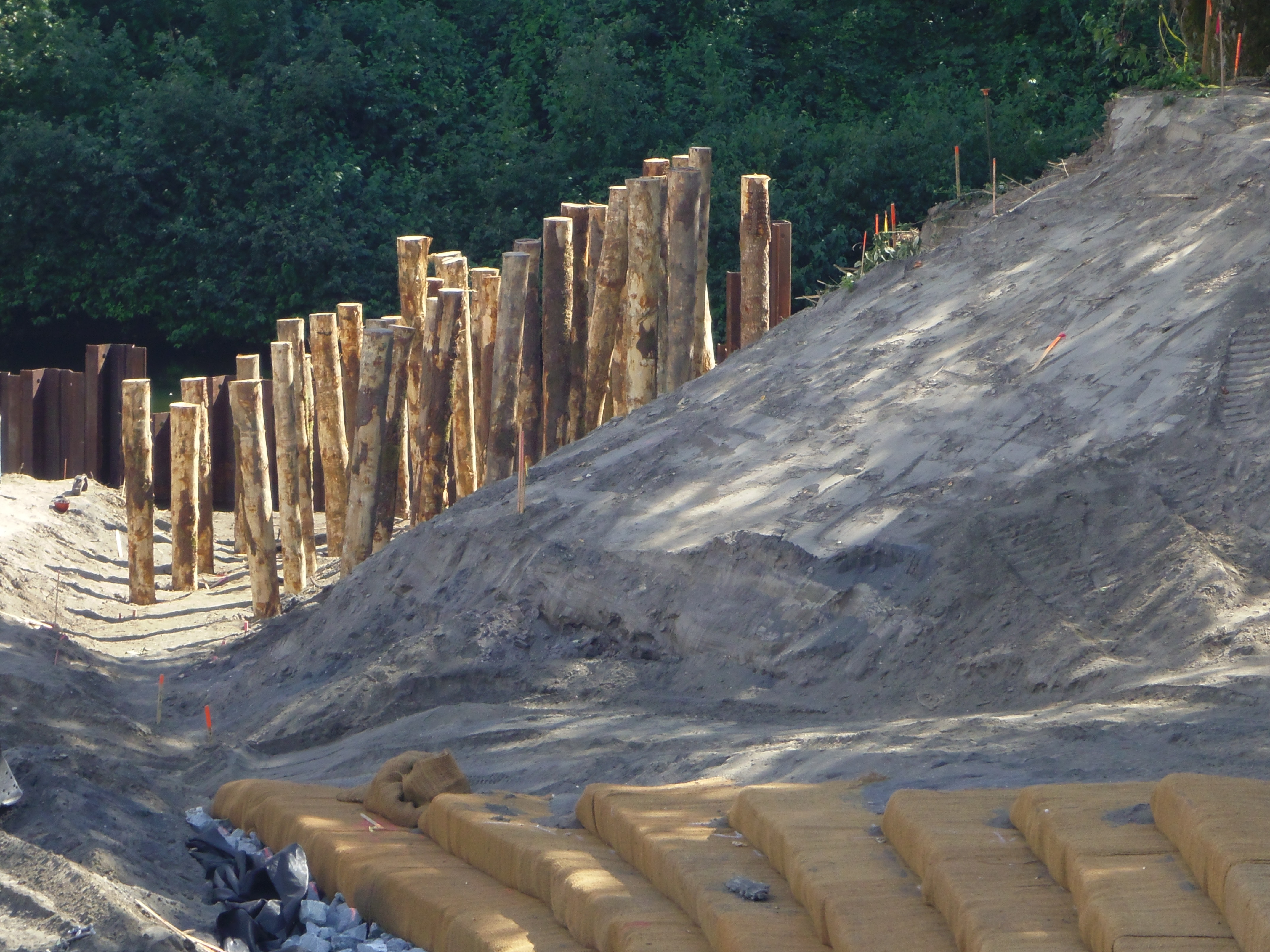
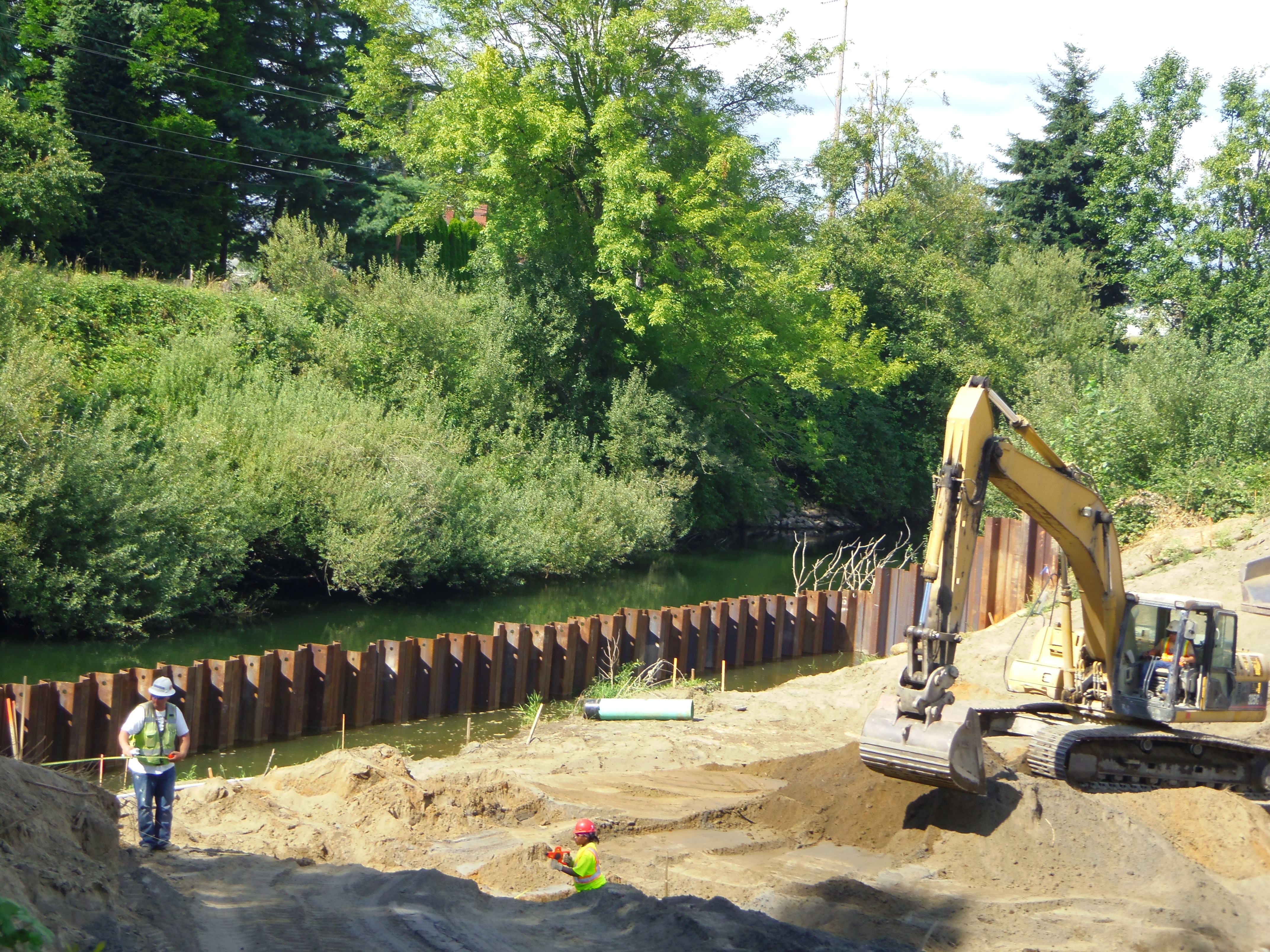
The Riverview Park Ecosystem Restoration Project reached a milestone in October when the channel inlet and outlet coffer dams were removed, allowing water to flow for the first time though the new side channel!  Crews raced against the clock to finish in-water work before migrating salmon entered this reach of the Green River.  They  excavated to finish grade, placed streambed gravel , rock slope protection, bioengineered soil lifts,  and anchored in-stream woody debris.   Careful monitoring ensured that salmon were not impacted by construction activities.

Since then, crews have hydroseeded the site, and now are planting more than 7,000 native trees, shrubs and ferns and more than 2,000 native emergent plants.   We look forward to seeing the plants all installed;  then, site will really begin to look like a natural channel….irresistible to the fish.   So, stay tuned for more updates!

Moon Festival at Tacoma Chinese Reconciliation Park

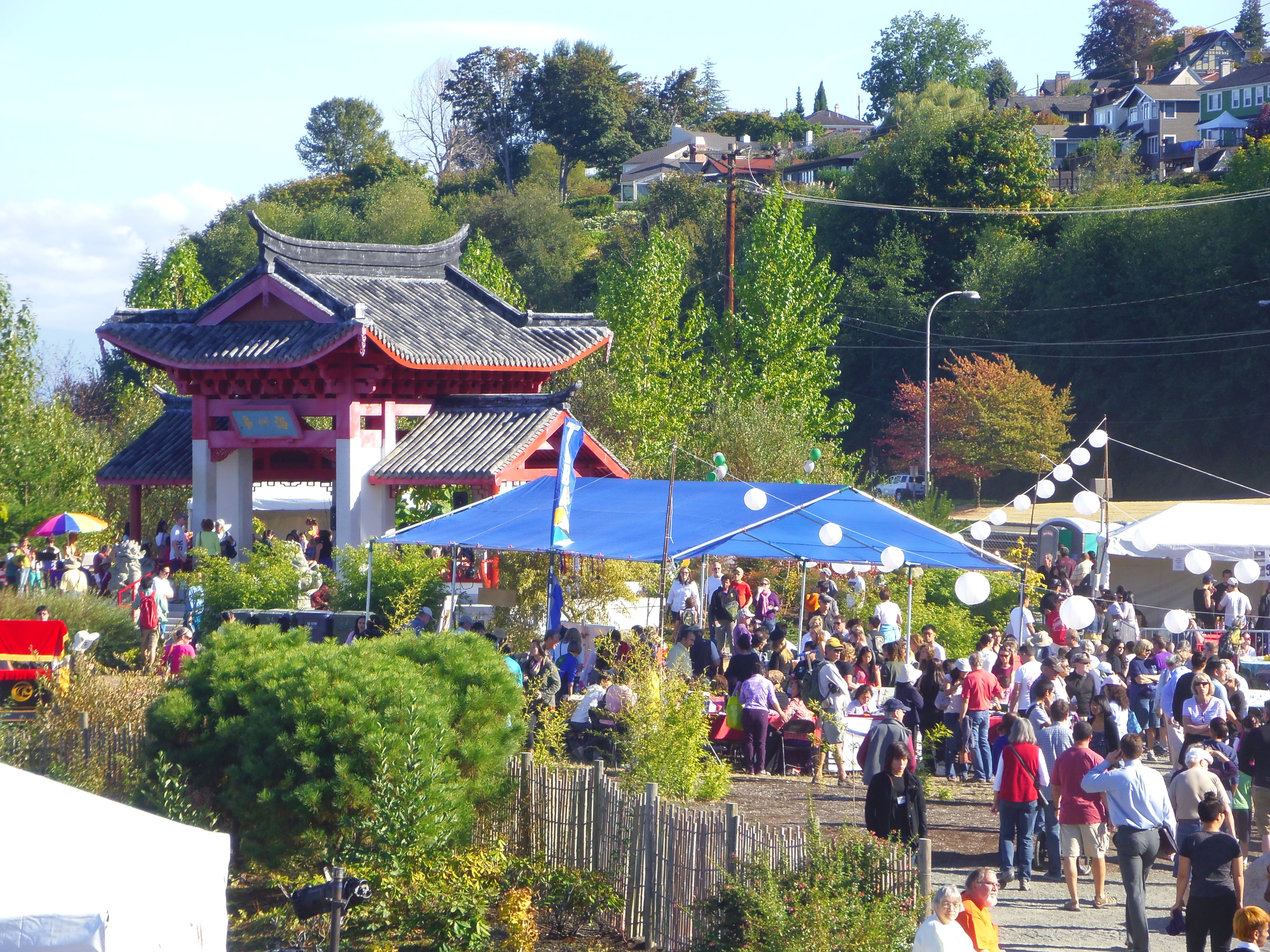
The Moon Festival or Chinese Lantern Festival is a popular lunar harvest festival celebrated by Chinese people. The festival is held on the 15th day of the eighth month in the Chinese calendar, close to the autumnal equinox.

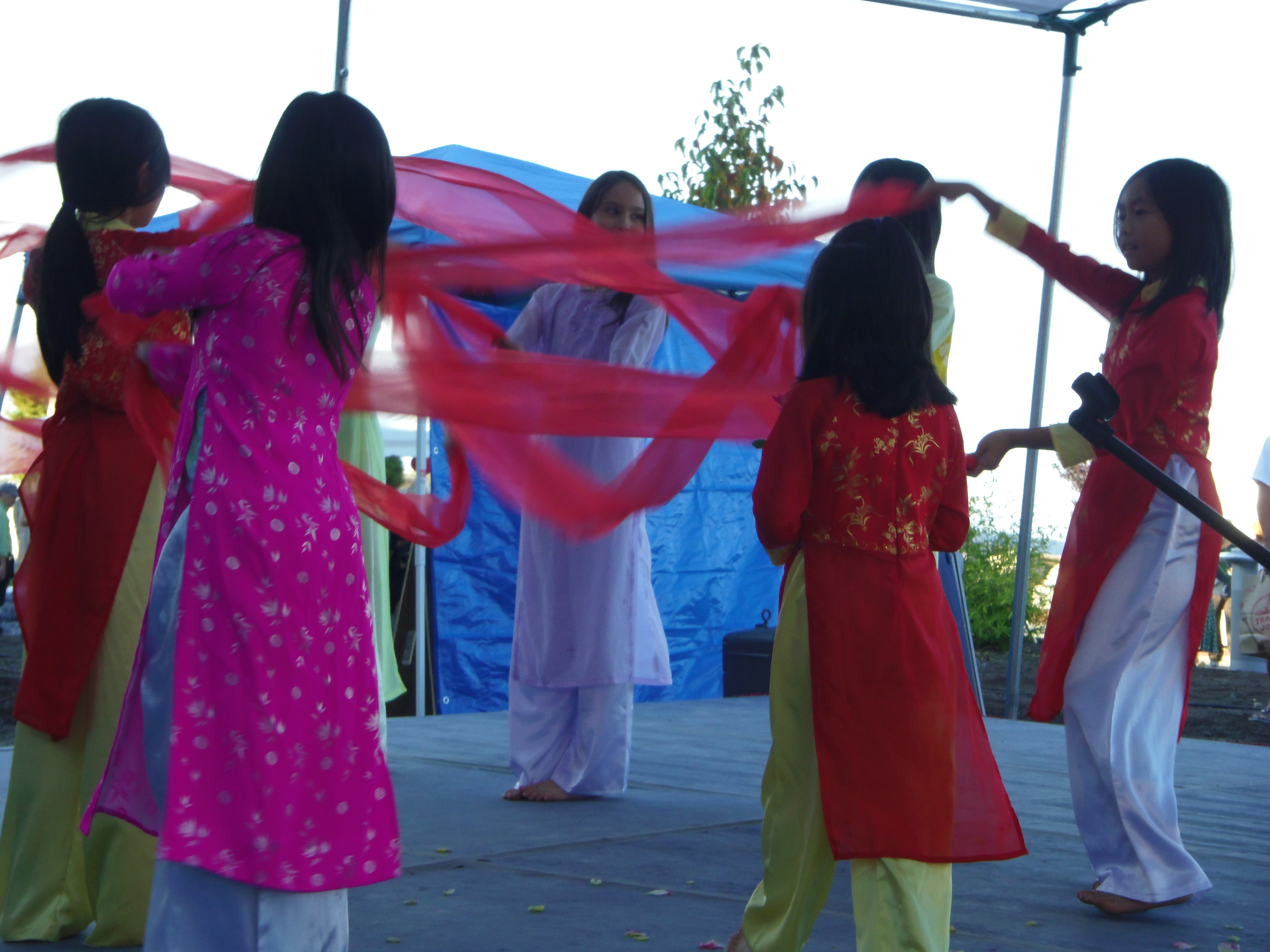
This year the Tacoma Chinese Reconciliation Foundation and the City of Tacoma hosted the first-ever Moon Festival at the Tacoma Chinese Reconciliation Park on September 29.  It was estimated that roughly 5,000 people turned out for the day-long event, which included dance and musical performances representing multi-ethnic traditions, food, calligraphy, tea ceremonies, and of course, the lantern parade after dusk.

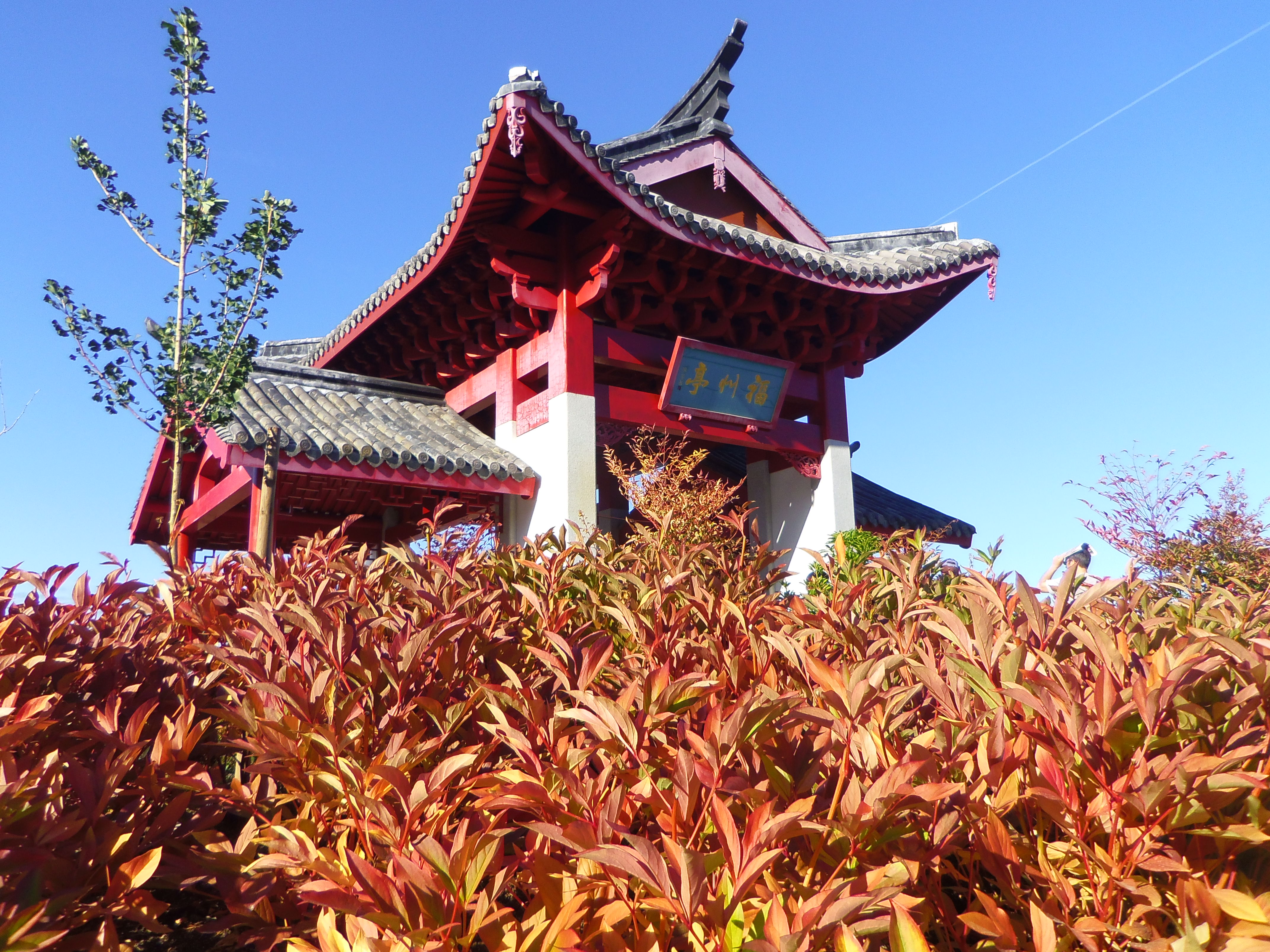
J.A. Brennan has been involved with the park design since completion of the Master Plan  in 2000.  Since then, two phases of construction have been completed, but they are only the beginning.   A 200-person gathering hall, reflection pond, open-air pavilion (ting), art display space and classrooms are in the cards, in addition to a beautiful array of plants  and outdoor rooms that are quintessential in a Chinese garden.

The turnout at the festival was astonishing.  Seeing the traditions represented in the talent-filled performances was truly inspiring.  The Tacoma Chinese Reconciliation Park provides a special place for reconciliation as well as celebration.  With each phase, the story unfolds and celebration continues.

For more information click here.


Aesthetic Enhancements for a City of Kent Flood Wall

Typical concrete floodwall? 

Or integration of art that signifies place? 

These were the choices the City of Kent had when considering improvements to the Boeing Levee at Three Friends Fishing Hole Park.  As the city neared completion of flood wall design for the Boeing Levee, inventive thinkers proposed adding art to the wall’s face along the span of the park.

Six weeks of design time

We were brought into the project as the structural engineering design of the flood-wall levees was nearing completion; a short time remained until the project would be going out to bid.  The short time-frame required quick thinking and an organized process.  Our design team’s familiarity with designing aesthetic treatments for walls and bridges allowed us to go from zero to fully developed construction drawings for wall textures and surface treatments in the allotted time.

An initial brainstorming session with the client led our designers to develop two alternative themes.  A nature-based Green River Ecology theme could honor the ecological story of the river.  The second potential theme employed the history and geomorphology of the Green River Valley, from pristine river to agricultural and then modern-day industrial corridor.  In either case, a part of the river’s story would be told for passers-by on the adjacent bike trail, park visitors, and adjacent industrial landowners.

Working out the details

Multiple material and treatment possibilities were discussed for the expression of the considered themes on the wall face.  Options included

  • Standard and custom formliners, which would create bas relief sculptural elements integral to the wall face
  • Sandblasted aggregate reveal
  • Sawcut patterns
  • Glass fiber reinforced concrete
  • Green wall

In the end, cost was a major consideration.  Research made it clear that the best way forward would be with custom formliners.

Ecological Story

With cost information and design alternative sketches in hand, our client opted to tell the ecological story.  Our designers got to work developing a story board with appropriate images.  Meetings with the client further refined the initial choices and allowed us to move forward with detail design of the custom formliners required to make this vision a reality.  We generated CAD drawings that went into the bid package on time and on budget.

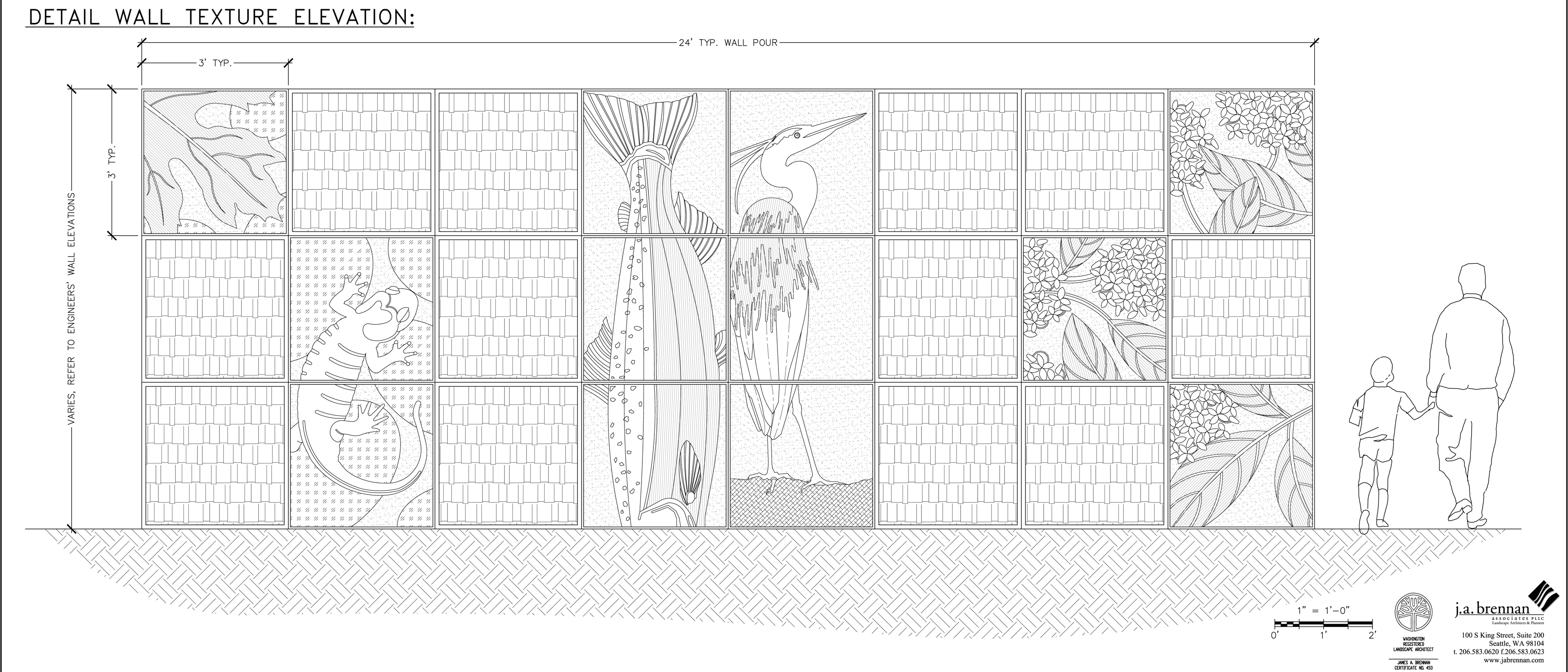
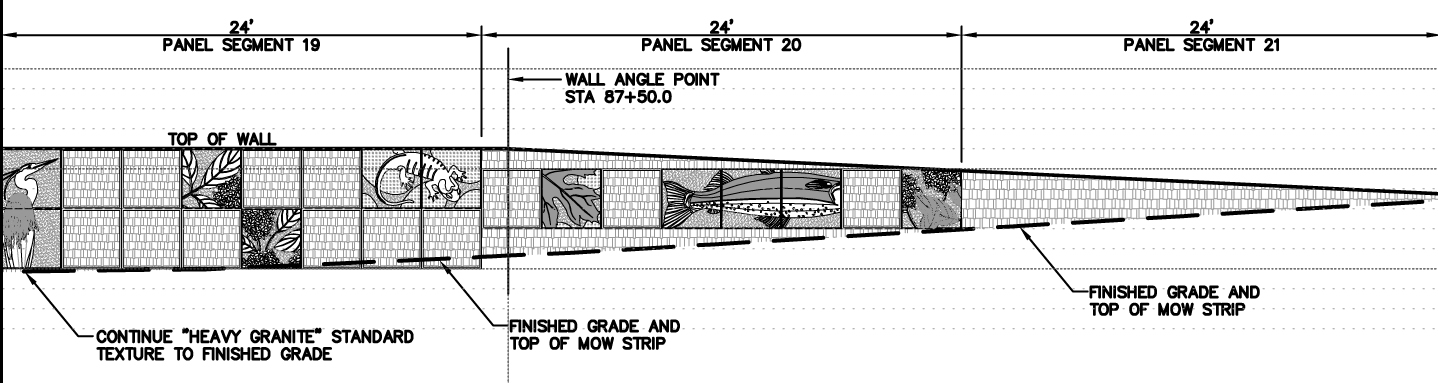
The final design celebrates the Green River with shapes, textures, and colors that are stylized representations of the life forms within the river system.  Recognizable images were selected: salmon, salamander, maple leaf, redtwig dogwood, and blue heron.

Custom formliner panels are 3’x3’, which are easily multiplied to cover the typical wall heights (front and back). The panels depict the wildlife/vegetation in detail surrounded with a subtle background texture.  Panels are designed so that they can be repeated in differing sequences and orientations, interspersed with standard formliner panels, thereby providing a rich and varying experience as one moves along the length of the wall.

In the end, our understanding of the aesthetic design process helped guide the client through a quick decision making process and resulted in a design that tells a place-sensitive story, turns a wall into art and enhances the park experience for all visitors.

The $2.65 million levee project is scheduled to begin construction mid August.

More information: Work to begin soon in Kent on $2.65 million levee project 

Riverview Park Ecosystem Restoration Update

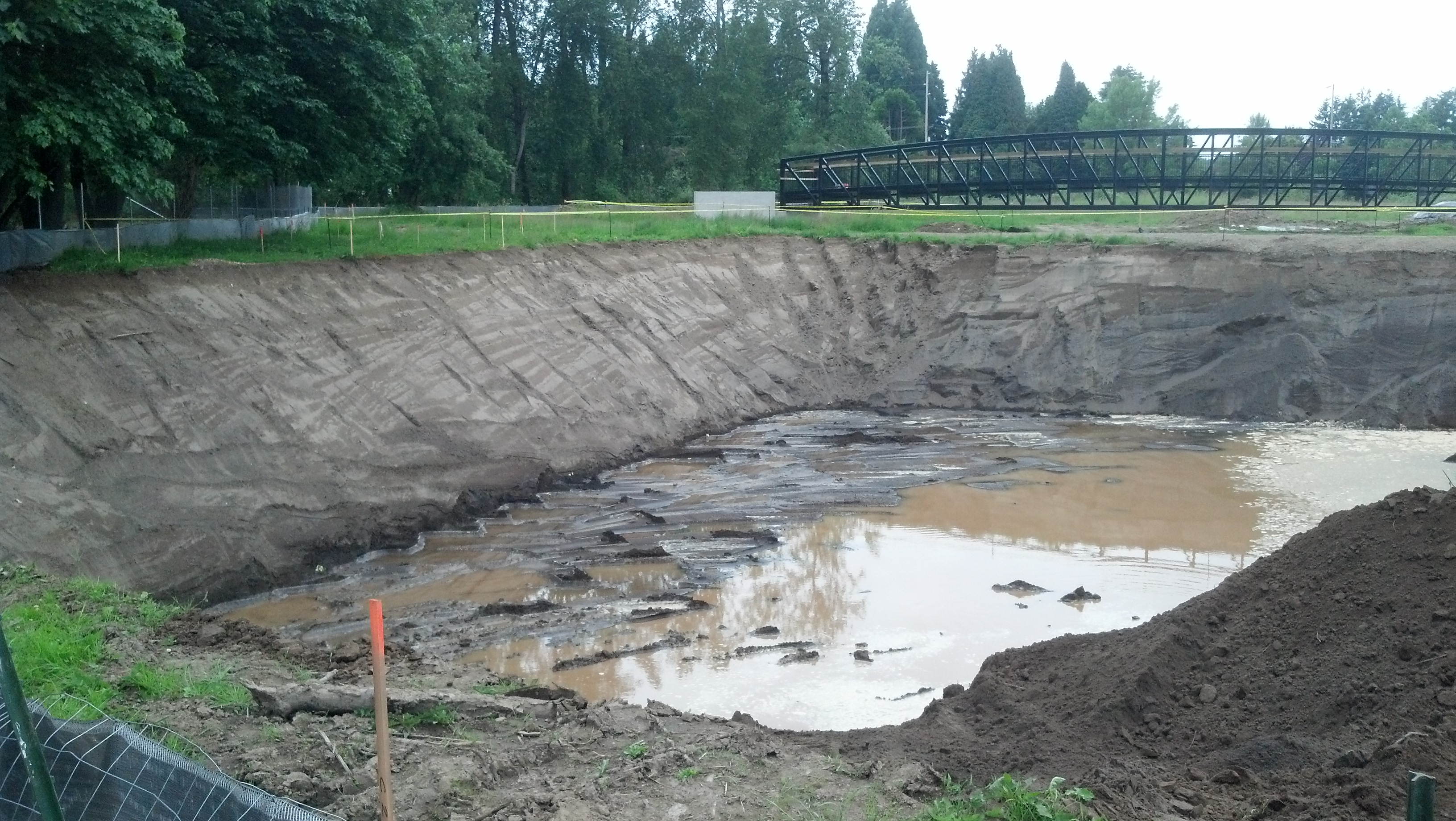
J.A. Brennan is part of a consultant team working with the City of Kent and the U.S. Army Corps of Engineers to create a habitat enhancement channel on the Green River at Riverview Park.  In this photo, the 25’-deep side channel excavation is nearly complete.

The contractor, Performance Systems, Inc., is busily working to complete the excavation and shore protection.  Excavators, rollers and dump trucks criss-cross the site moving and grading soil and fill materials.

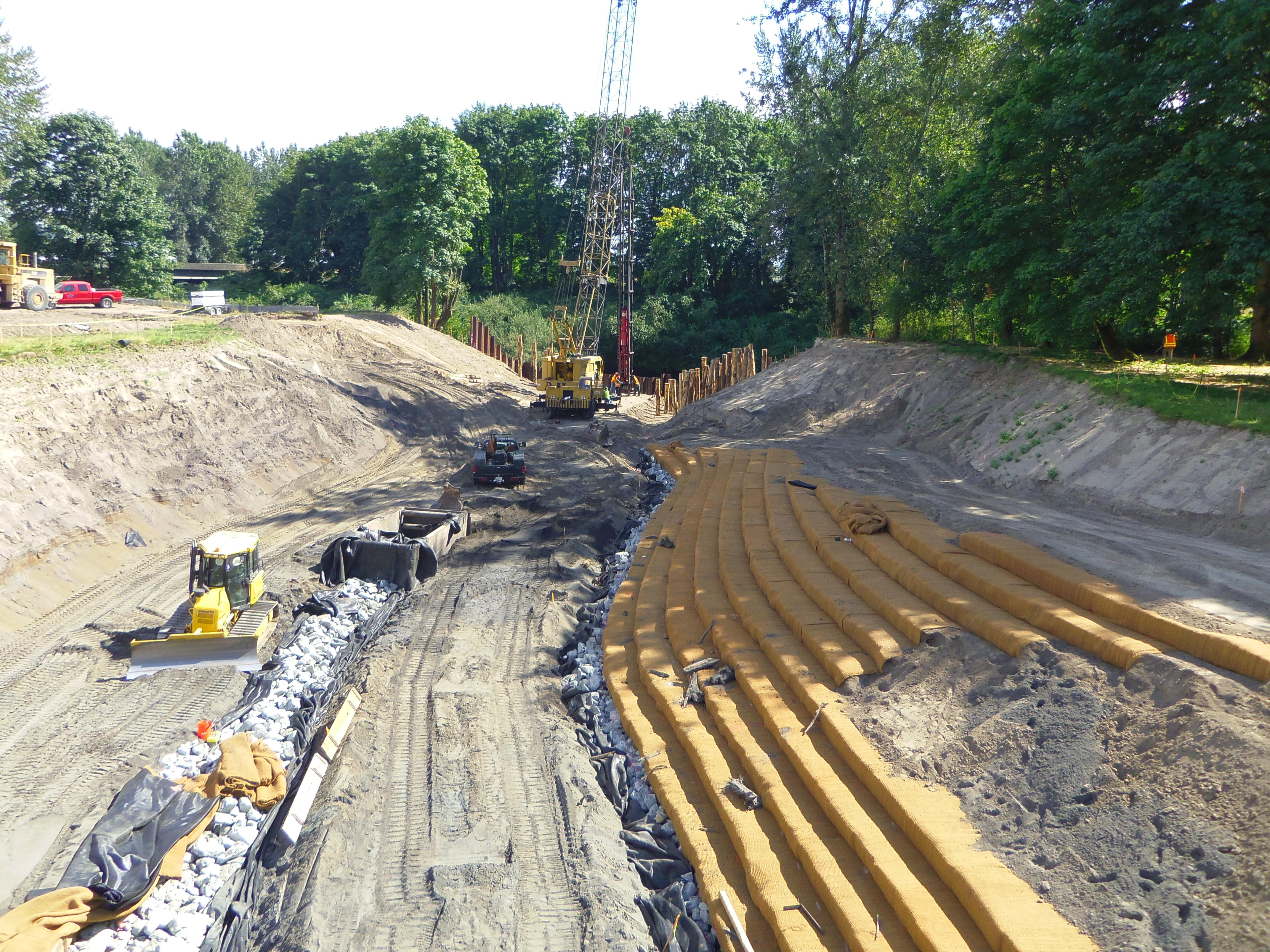
Looking up-channel, a crane installs coffer dam piles.  In the foreground, soil lifts – soil wrapped in geotextile fabric – are installed.  The lifts will be planted with both container plants and live stakes.  Tetra Tech, Inc., the prime consultant and project engineer, is providing a variety of bio-engineering solutions to create a naturalistic and protected channel bank.

The foundation of the channel inlet constructed log jam structure is in place.  This sturdy bio-engineering solution by Tetra Tech, Inc. is the first line of defense  against potentially high-velocity, high-volume storm flows surging down the Green River.  Live stake plants will provide further erosion control, and help naturalize the constructed log jam.

The approximately 125’ long pedestrian bridge is in place.  Riverview Park visitors will gain an exceptional view of the new side channel, and access to the island (on the right) between the channel and the Green River.  A loop path around the island will meander through meadow and a mature Cottonwood canopy.  Native plant restoration along the Green River banks will enhance the existing native riparian corridor.

Looking at the channel outlet, you can see the coffer dam.  An excavator-operator continues to dig out this area to reach channel bottom grades.  PSI continuously dewaters the area behind the coffer dam to keep working conditions nice and dry.

For more information see the Seattle District US Army Corps of Engineers’ webpage.

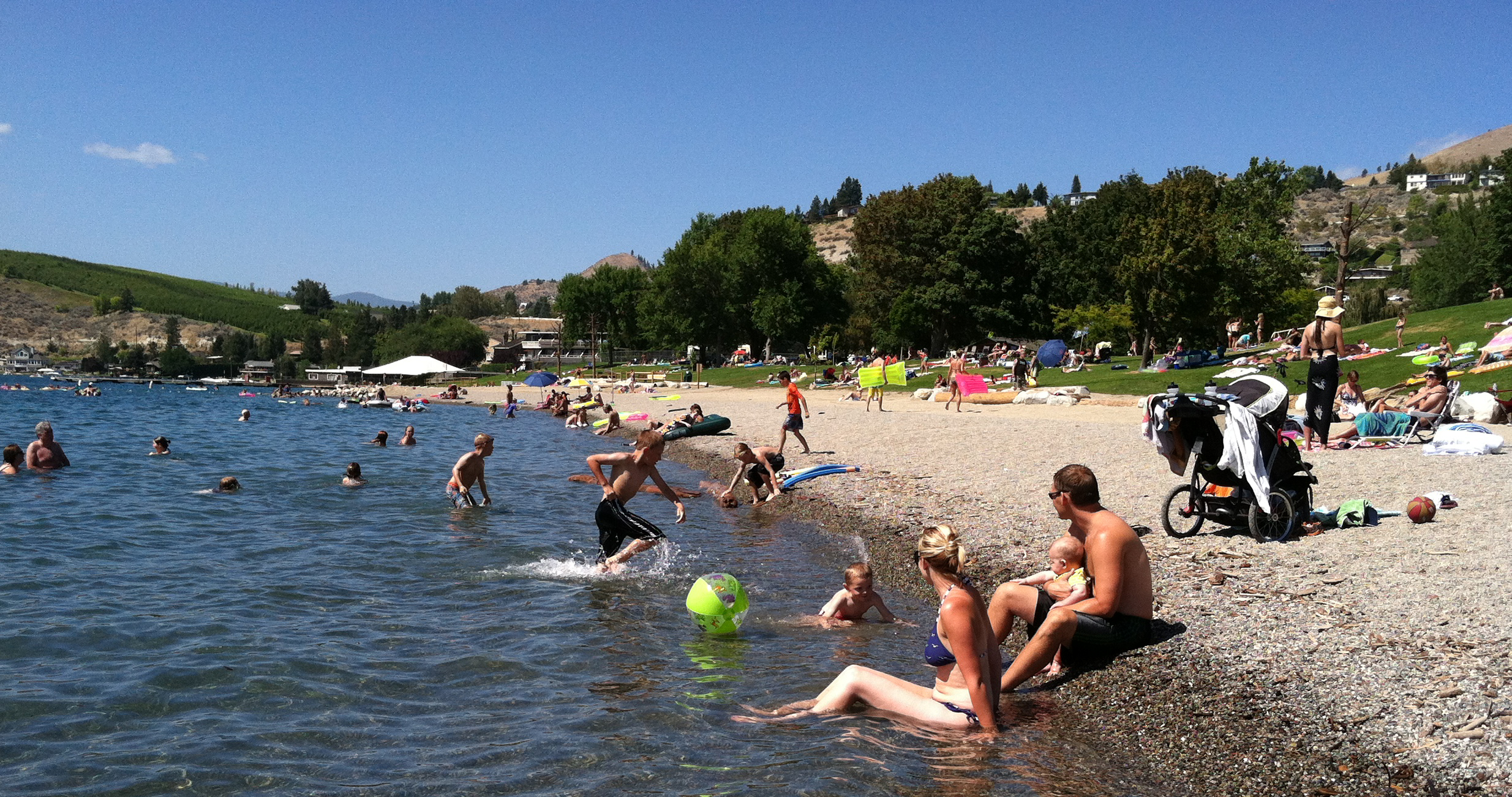
Don Morse Park Beach Restoration Update, Chelan, WA

Image

Park use is up substantially and visitors are having a great experience now that the bulkhead has been buried and the park has a beach designed by the J.A. Brennan Associates team.  Next spring native aspen trees and other vegetation will be added to create shade, beautify the site, and enhance the riparian habitat.

Swan Creek Public Meeting

Jim Brennan

Last night Jim and Mike presented the schematic design for the 1st phase of Metro Parks Tacoma’s Swan Creek Park.  The meeting was open to the public, and held at the Portland Avenue Community Center in Tacoma’s Eastside neighborhood, where the 380-or so acre park lies.  The meeting was attended by neighborhood residents, former-residents, members of the Friends of Swan Creek, community gardeners, and other folks interested in the proposed improvements.  The plan calls for a new gathering space focused around community gardening.  This area will serve as a launching point for park visitors to venture off into the miles of wooded trails being added at the park.  The improvements will surely give east side residents a good means to access and behold this gem of a park.

Evaluating the Performance of Bio-Swale Plant Material

by Drew Coombs

July 2012

Background

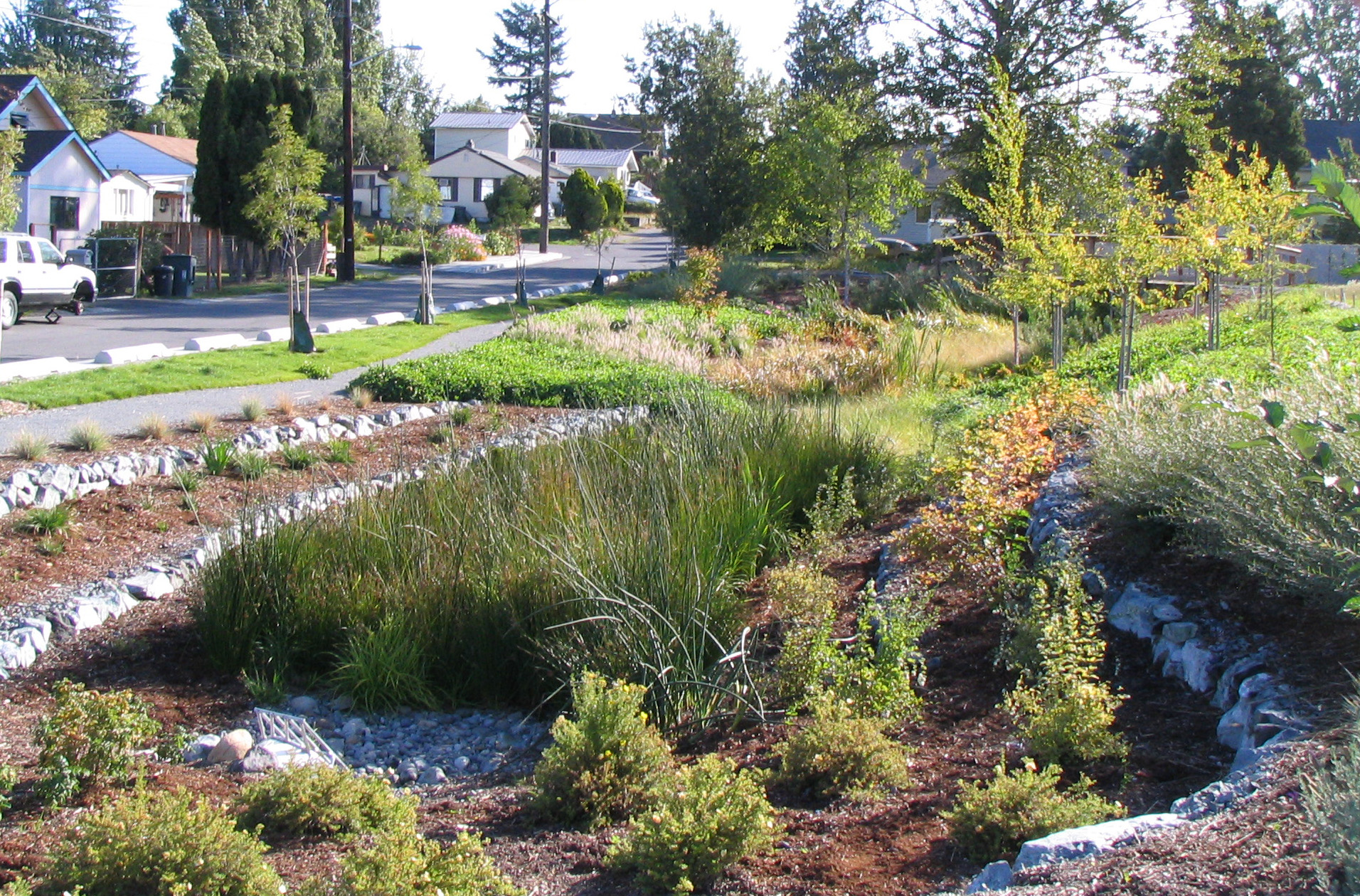
In 2008-2009 J.A. Brennan provided design services for a bio-filtration drainage system at Marra-Desimone Park.  We collaborated with Davido Consulting Group to improve roadway drainage in this South Park neighborhood for Seattle Public Utilities (SPU).   For more background info see here.

We return to the site two to three times a year to evaluate the performance of the plants and to see how the system as a whole is functioning.  The focus of this article will be about plant selection and the success of certain species.  I’ve kept the discussion to a select few plants as there is a diverse plant palette and I could get carried away…

Performance

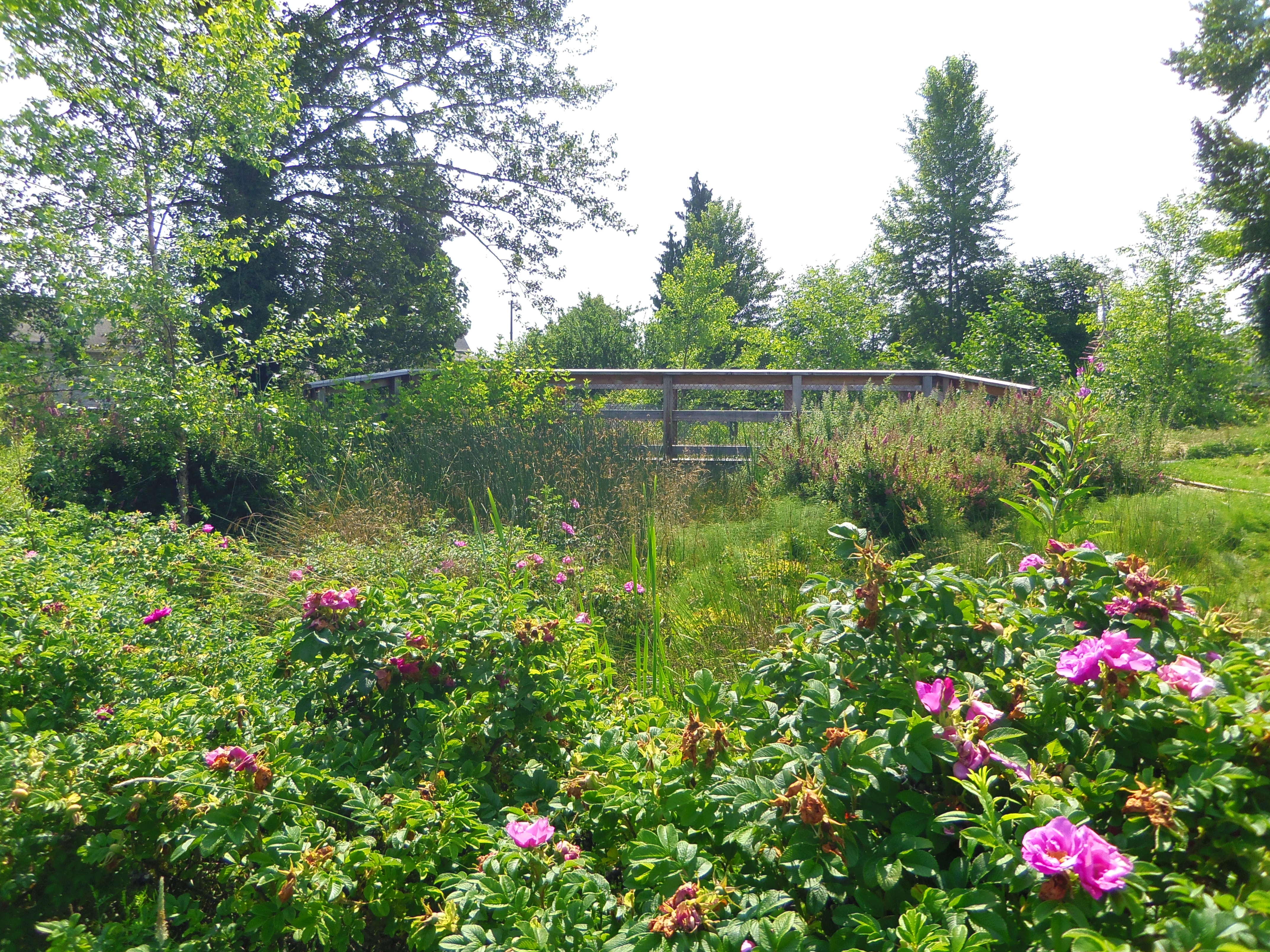
With the early onset of summer I visited the site with my co-worker Meghan to see how the system was faring.  Given that the local weather personalities had recently described the season as Junuary due to unseasonably wet and cool weather in our region I was anticipating the plants to only be performing at an O.K. level.  To my pleasant surprise the majority of the plants looked robust, vigorous, lush, beautiful and healthy.  (How many words can you use to describe a good looking plant!?) 

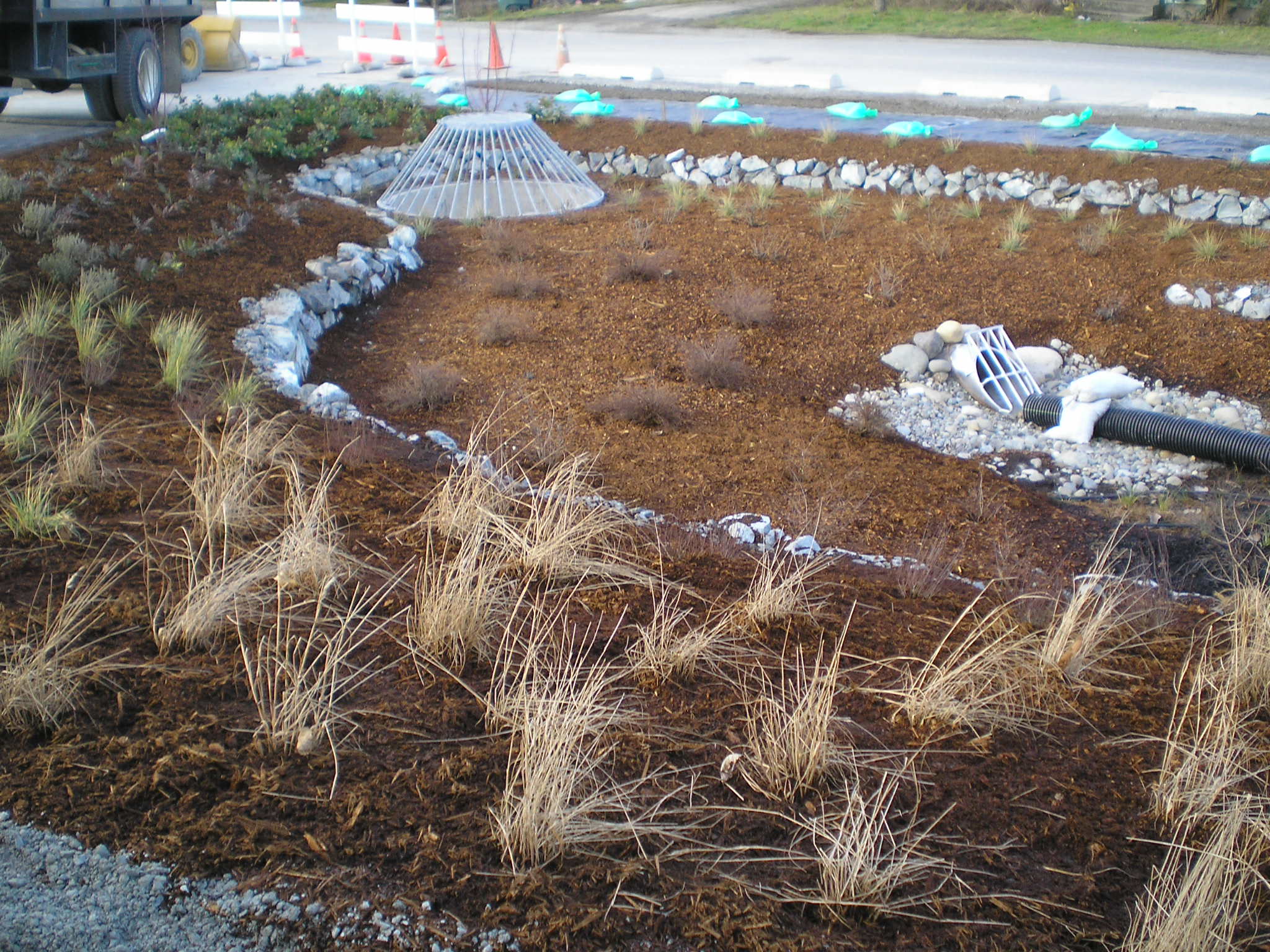
Post Construction, September 2009

Plant Selection

During design we carefully selected emergent marsh species appropriate for the wet and dry conditions of the bio-filtration system.  The upland plants reflect the context and character of the Marra Farm community garden and urban farm environment.  A selection of native plants and fruiting ornamental plants were used to attract wildlife and suggest the farm quality of the site.

During construction, 2009

Seeds versus Plugs?

Plants were an expensive part of the project.  During design, to meet the project’s budget, we made a decision to use a combination of seed and plugs in the bottom of the bio filtration swale.  The combination of seed and plugs of emergent species reduced the quantity of emergent plugs required and provided some savings during construction.   (Emergent plugs are more expensive than seeds).

I have to say after four years, it’s not possible to distinguish the areas that were seeded from the areas that were planted with plugs.  The system as a whole appears to be performing well.

Performance

The emergent plants species doing particularly well are the Carex sp (sedge) and the Scirpus microcarpus (small fruited bulrush).  Both are content and performing as planned.

Of the shrub species, Cornus sericea ‘Kelseyi’ (Kelsey dogwood) and Salix purpurea (Arctic willow) look wonderful.

We used a select few groundcover species.  The one plant that is struggling and has had a high rate of loss is Mahonia nervosa (Low Oregon grape).  The site may have been too exposed for this particular plant.

Overall the plants are performing quite well and the system as whole is performing as designed.  There is little evidence of invasive plants like blackberry or reed canary grass.

The performance of the plants is a combination of the selection but also a measure of the ongoing maintenance by the owner, in this case SPU and Seattle Parks.  It is my understating that SPU staff continues to maintain the swale.

In conclusion, with proper maintenance and irrigation, it is apparent, given the right conditions during the early establishment period, that the application of seed in combination with plugs appears to be a successful approach within this bio-filtration system.

Riverview Park Ecosystem Restoration

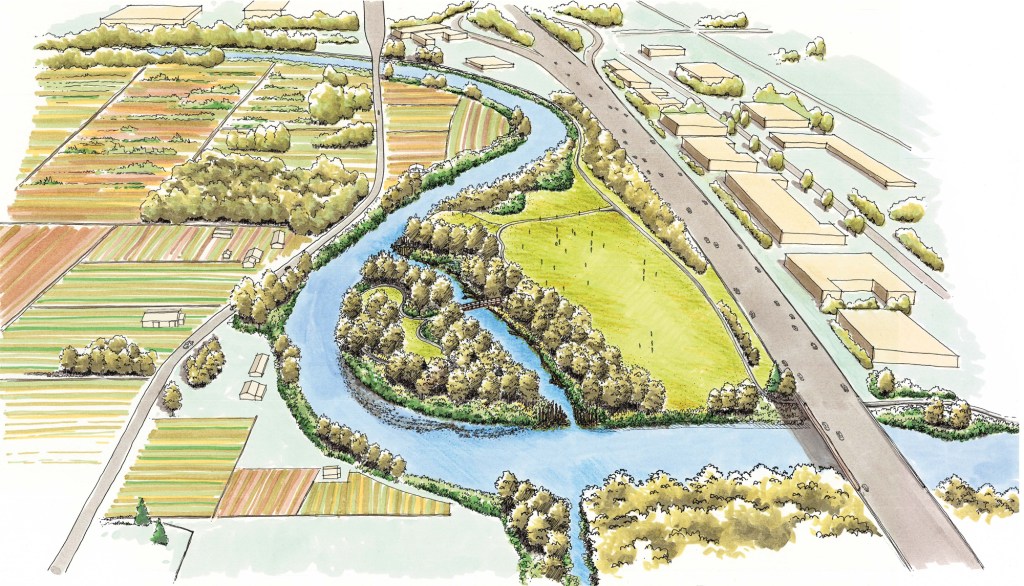
J.A. Brennan recently completed multiple illustrative graphics, which were used in the project ground-breaking ceremony, and in other public outreach and informational efforts.

J.A. Brennan is a member of the consultant team that worked with the City of Kent and the U.S. Army Corps of Engineers (Corps) to design a Habitat Enhancement Channel at Riverview Park.  This newly created side channel is part of a pilot project by the Corps to restore side channel and low-flow environments along the Green River for the benefit of spawning salmon and steelhead.  Previously, J.A. Brennan developed the master plan for the park.  For this project we were able to provide valuable insights to the project with our site experience and park design expertise, which helped coordinate the City’s park plans with Corps habitat objectives.

J.A. Brennan developed contract documents for trail design, planting and irrigation of approximately four acres of restoration area, including native aquatic, riparian and upland environments.  Wooded trails and a new 200-foot long bridge, will provide public access to this restoration project, and educational signage and viewpoints will further enhance the visitor’s experience and provide information about the Green River ecosystem.

Construction of the new side channel at Riverview Park in Kent is underway! The new side channel will offer rearing habitat for endangered salmon species including Chinook, steelhead and bull trout. The side channel is a partnership of the U.S. Army Corps of Engineers , the city of Kent, the Water Resource Inventory Area 9 (WRIA 9) Ecosystem Forum, the Washington State Salmon Recovery Funding Board and the King Conservation District.
Design a site like this with WordPress.com
Get started