Swan Creek Public Meeting

Jim Brennan

Last night Jim and Mike presented the schematic design for the 1st phase of Metro Parks Tacoma’s Swan Creek Park.  The meeting was open to the public, and held at the Portland Avenue Community Center in Tacoma’s Eastside neighborhood, where the 380-or so acre park lies.  The meeting was attended by neighborhood residents, former-residents, members of the Friends of Swan Creek, community gardeners, and other folks interested in the proposed improvements.  The plan calls for a new gathering space focused around community gardening.  This area will serve as a launching point for park visitors to venture off into the miles of wooded trails being added at the park.  The improvements will surely give east side residents a good means to access and behold this gem of a park.

Evaluating the Performance of Bio-Swale Plant Material

by Drew Coombs

July 2012

Background

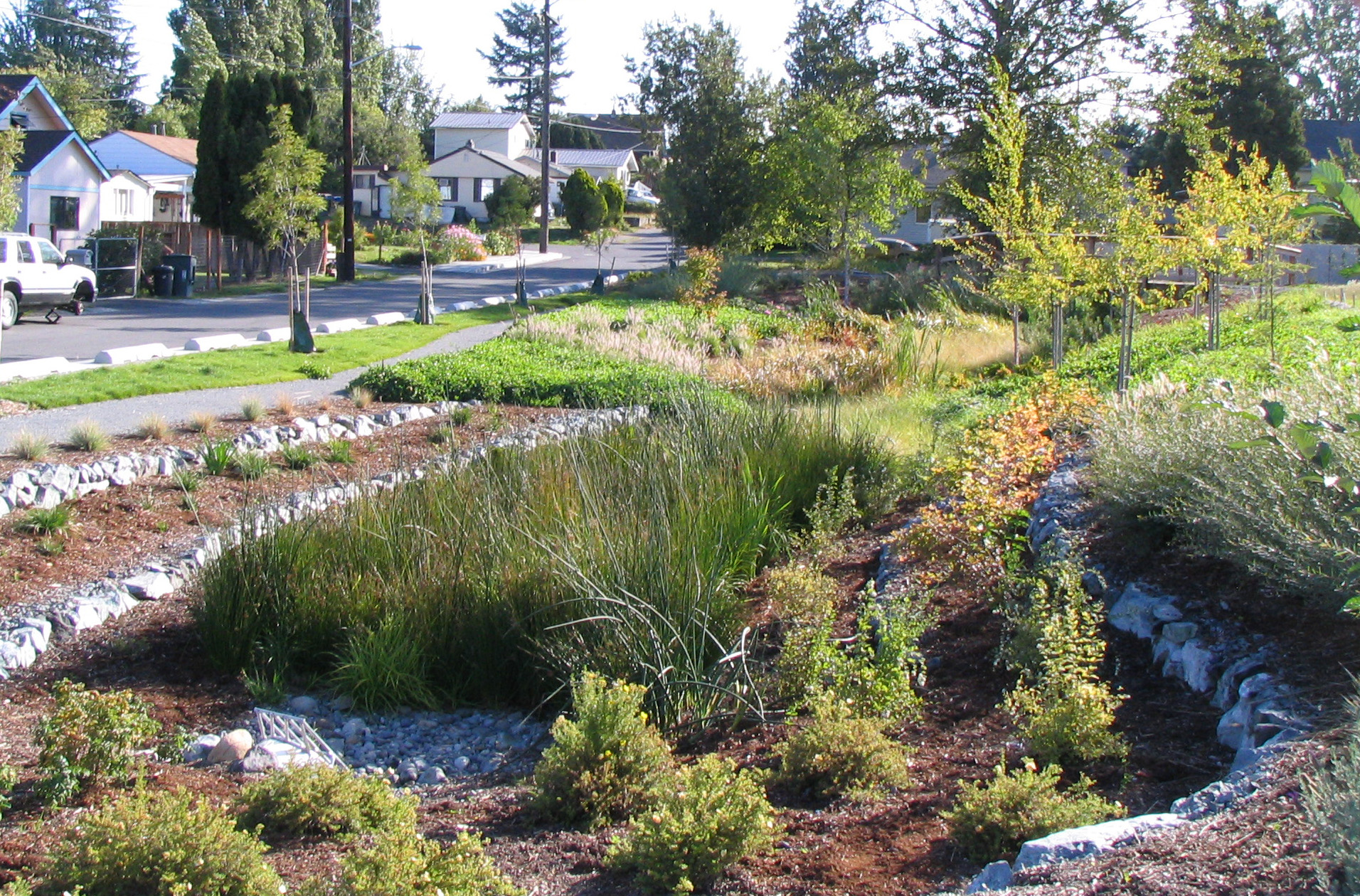
In 2008-2009 J.A. Brennan provided design services for a bio-filtration drainage system at Marra-Desimone Park.  We collaborated with Davido Consulting Group to improve roadway drainage in this South Park neighborhood for Seattle Public Utilities (SPU).   For more background info see here.

We return to the site two to three times a year to evaluate the performance of the plants and to see how the system as a whole is functioning.  The focus of this article will be about plant selection and the success of certain species.  I’ve kept the discussion to a select few plants as there is a diverse plant palette and I could get carried away…

Performance

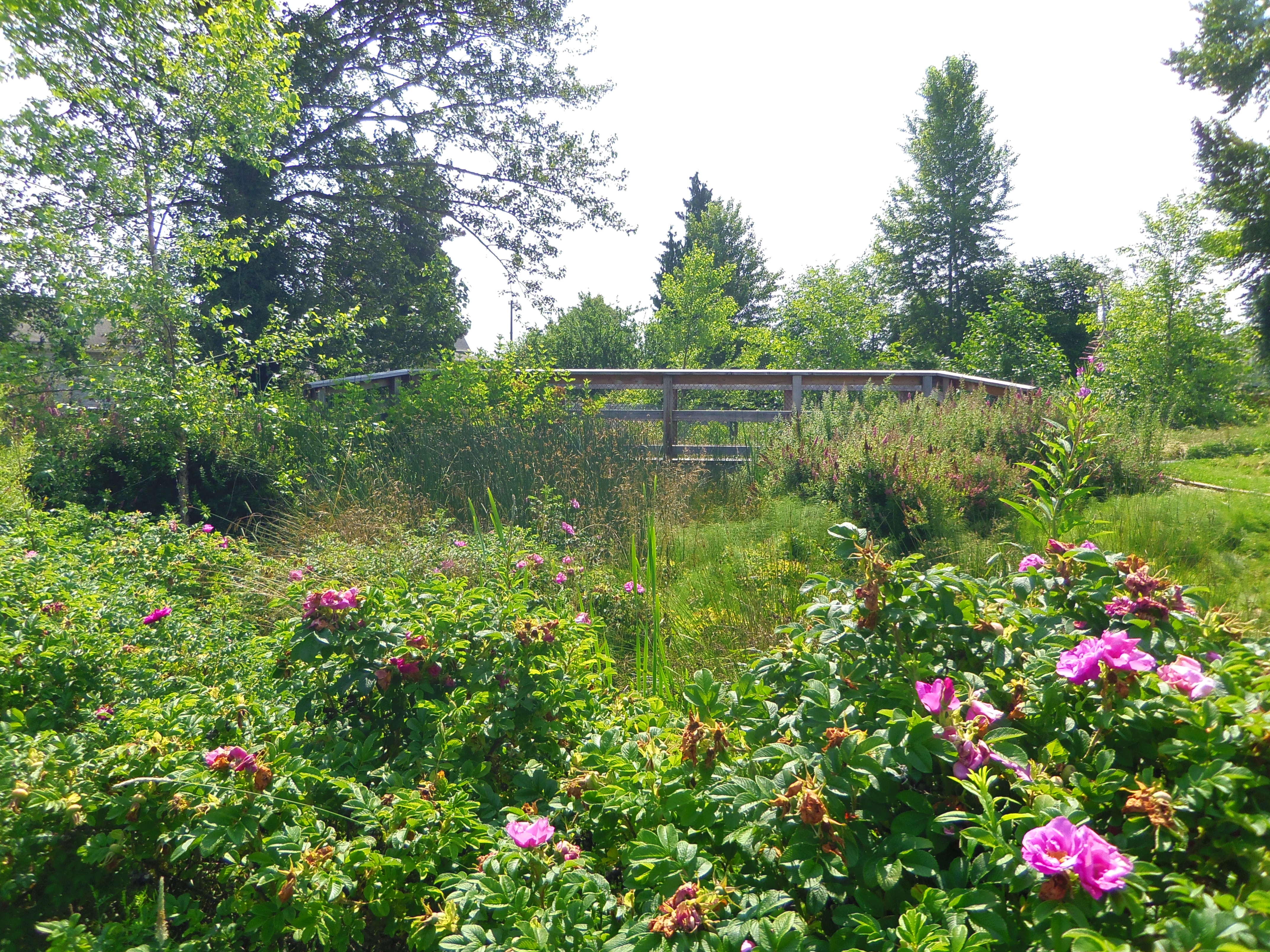
With the early onset of summer I visited the site with my co-worker Meghan to see how the system was faring.  Given that the local weather personalities had recently described the season as Junuary due to unseasonably wet and cool weather in our region I was anticipating the plants to only be performing at an O.K. level.  To my pleasant surprise the majority of the plants looked robust, vigorous, lush, beautiful and healthy.  (How many words can you use to describe a good looking plant!?) 

Post Construction, September 2009

Plant Selection

During design we carefully selected emergent marsh species appropriate for the wet and dry conditions of the bio-filtration system.  The upland plants reflect the context and character of the Marra Farm community garden and urban farm environment.  A selection of native plants and fruiting ornamental plants were used to attract wildlife and suggest the farm quality of the site.

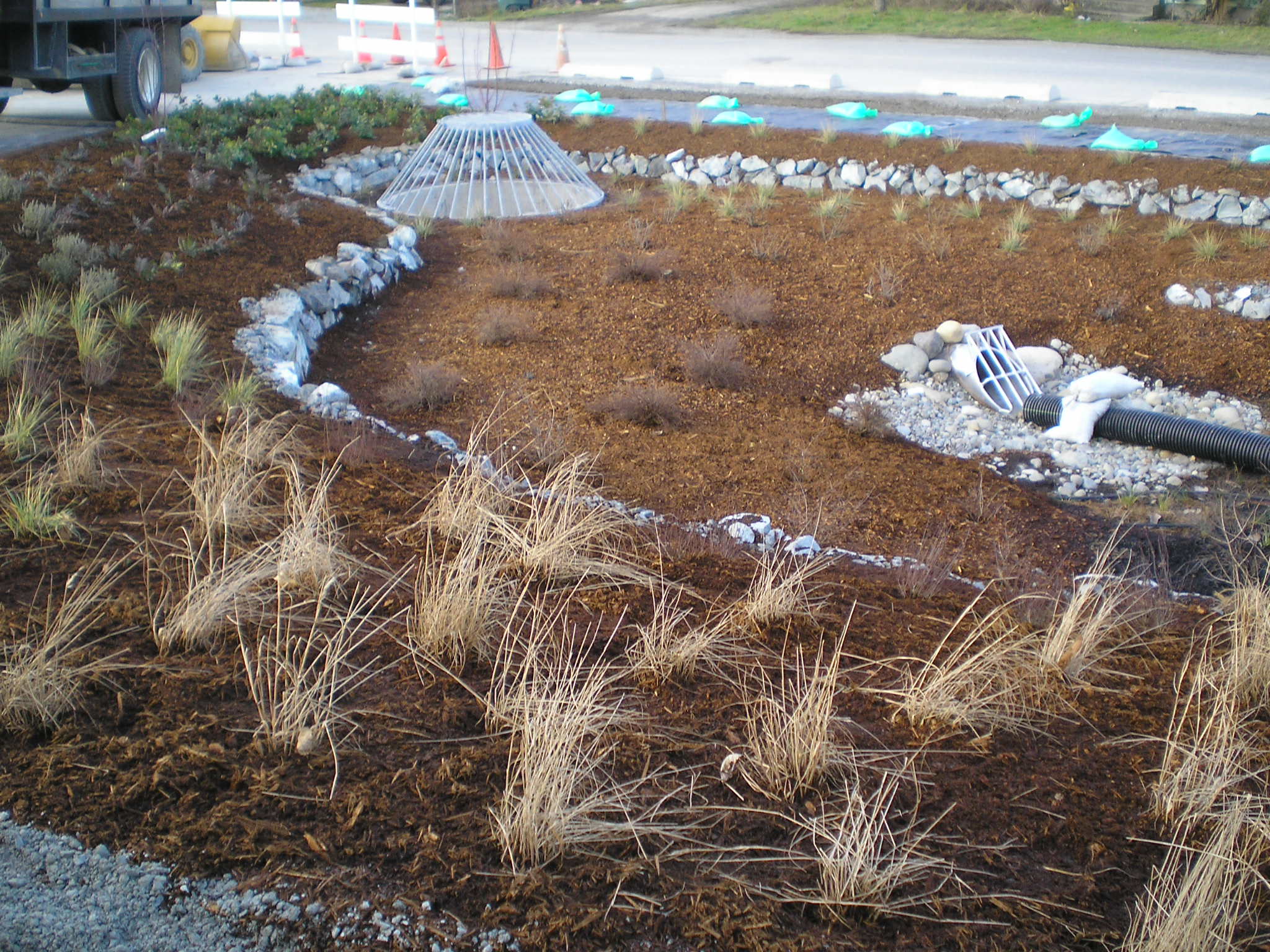
During construction, 2009

Seeds versus Plugs?

Plants were an expensive part of the project.  During design, to meet the project’s budget, we made a decision to use a combination of seed and plugs in the bottom of the bio filtration swale.  The combination of seed and plugs of emergent species reduced the quantity of emergent plugs required and provided some savings during construction.   (Emergent plugs are more expensive than seeds).

I have to say after four years, it’s not possible to distinguish the areas that were seeded from the areas that were planted with plugs.  The system as a whole appears to be performing well.

Performance

The emergent plants species doing particularly well are the Carex sp (sedge) and the Scirpus microcarpus (small fruited bulrush).  Both are content and performing as planned.

Of the shrub species, Cornus sericea ‘Kelseyi’ (Kelsey dogwood) and Salix purpurea (Arctic willow) look wonderful.

We used a select few groundcover species.  The one plant that is struggling and has had a high rate of loss is Mahonia nervosa (Low Oregon grape).  The site may have been too exposed for this particular plant.

Overall the plants are performing quite well and the system as whole is performing as designed.  There is little evidence of invasive plants like blackberry or reed canary grass.

The performance of the plants is a combination of the selection but also a measure of the ongoing maintenance by the owner, in this case SPU and Seattle Parks.  It is my understating that SPU staff continues to maintain the swale.

In conclusion, with proper maintenance and irrigation, it is apparent, given the right conditions during the early establishment period, that the application of seed in combination with plugs appears to be a successful approach within this bio-filtration system.

Japan Trip Part 1: Tokyo Observations

By Mike Perfetti

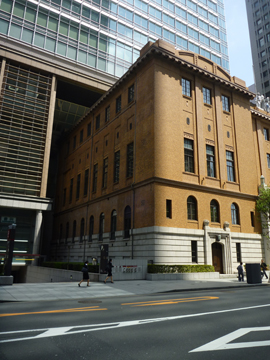
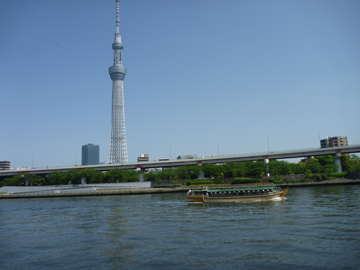
This spring I spent about 10 incredible days in the Land of the Rising Sun – Japan.  In Japan, I found a complex story of a culture and landscape – a country full of contrasts and contradictions evident in its landscape, culture, and history.  The island of Honshu is home to the world’s largest city, Tokyo.  This first installment of my trip journal is about Tokyo–where my trip started and ended–an incredibly immense web of buildings, tracks and roads that has unalterably reshaped my perspective on cities.

Tokyo’s metropolitan area population is the largest in the world at astounding 32,450,000!1 The population density of 10,491 people per square mile is nearly 20 times as dense as that of my hometown, Seattle, at 543 people/square mile2.  Tokyo is a bustling, if not overwhelming city connected by a complex array of trains and subways; Cars are present of course, but the design of Tokyo makes owning and storing a car inconvenient and expensive.  In Tokyo, there are 308 cars per 1,000 people3, compared with Seattle, which has about 743 cars per 1,000 people.4

The immensity of Tokyois well-known.  But how livable is Tokyo?  Monocle’s 2011 “Most Livable Cities Index” compared 25 cities looking at criteria such as safety, international connectivity, climate/sunshine, quality of architecture, public transportation, tolerance, environmental issues and access to nature, urban design, business conditions, and medical care.  Tokyo placed 9th; Seattle placed 25th.5

My own experience tells me that Tokyo is an active, exciting and convenient city.  Goods and retail aren’t confined only to business districts; seemingly every street has a convenient store, izakaya (pub), and market.  Tokyoites, by nature of the city’s density, deal with conflict and intrusions of personal space constantly.  It was interesting to see how Tokyoites are unwary to such encounters; they display an amazing tolerance for such things – a matter of survival and sanity I would suppose.  Road rage is seemingly absent.   The Japanese people are incredibly polite and share a culture of collectivism. .

In some ways, Seattle cannot be compared to Tokyo; but, to me there is a lesson for us as we develop into a bigger and denser City — that it can be done on a scale beyond what we’ll ever see here, and can be done well.   We’ll have to consider our dependence on cars and our notion of personal territory to make this work.

As much as anything, though, my observations of Tokyo have reinforced my conviction that public open spaces, parks and access to nature are essential to creating healthy and livable cities.  Tokyo is beginning to embrace waterfronts as open space, and historic temples and the occasional park provide essential open spaces for people.  In Seattle, we have a unique appreciation and relationship with our sublime landscape; environmental stewardship and community are vital components of our culture, and our commitment to parks and open space is strong, giving our city amazing potential to become one of the great cities of the world.

__________________

Sources

1 Wikipedia, “List of metropolitan areas by population”

2 Wikipedia, “Seattle Metropolitan Area”

3WEC “Energy for Megacities” Study”: Tokyo case study by Paula Restrepo Cadavid, revised by Pierre-Noel Giraud 07/09/2010

4 Wikipedia, “World’s most livable cities”

5Metro Areas Ranked by Vehicles Per 1,000 Residents (construction, school)”

Recreational Beaches: The Great Pea Gravel Debate

Sandy swimming beach: the preferred solution

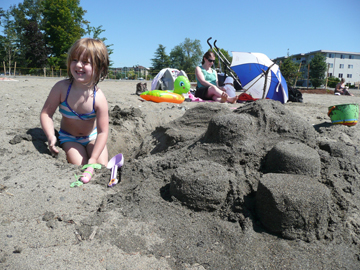
Most beachgoers prefer a sandy beach for swimming and enjoying the shoreline.  But – as happens so often in our seawalled and bulkheaded environs –sand washes away with the current or wave action.

Due to the dynamic nature of shorelines, most swimming areas require continual maintenance to keep them in the shape that the swimming public demands.  When developing a new swimming beach or restoring an old one the first thought is usually: sand, bring in more sand!

To look at the situation with foresight, though, requires studying site conditions.  Where did the sand go?  Is a bulkhead or seawall impacting erosion?  Often wind and wave analyses are required.

In many cases, replenishing with sand is not a sustainable solution.  Sand blows away.  Sand drifts away.  Looking at the long-term picture and saving owner expense requires considering, and often implementing, a less-favored solution, replenishing or filling with pea gravel, which is a more stable material.  Many revitalized swimming and hand-carry boat launch beaches in high wave environments use pea gravel.

Even pea gravel will require ongoing maintenance / replenishment, but will save money over the long-term, with considerably more infrequent replenishment required than sand.

The compromise: 

Testing for comfort
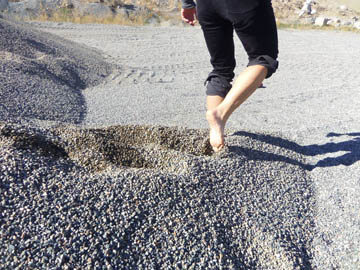
Comfort.  Warm sand ala Waikiki is the expectation when one thinks swimming beach.  But even Waikiki Beach requires continual replenishment.  Rounded pea gravel ranks lower in comfort.

Benefits

The other benefits of pea gravel: improved fish and wildlife habitat.  Gravel provides spawning substrate for fish.  This is something that appeals to the agencies and assists in the likelihood of permit approval.

What does creating a sustainable beach involve?

Selecting pea gravel: evaluating color, size, and shape

One consideration in the selection of beach material is the beach’s slope and the available land to place the preferred material.  Coastal engineers study wind and wave action and build models that predict how material will move along the shore.  The size and shape of potential materials are run through the model, allowing for scenarios that analyze different size materials, allowing designers to study costs and benefits of the materials.  Examining the models allows designers to create a final design that minimizes maintenance costs and maximizes user comfort.  Though pea gravel is more expensive initially, it is more likely to stay in place, and cost less in maintenance dollars over the long-term, resulting in a cost-effective, sustainable design solution.

Aesthetics: How to make it beautiful? 

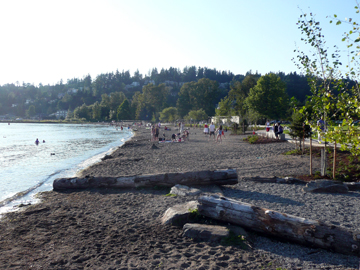
Logs and shoreline plantings at Juanita Beach Park

Landscape architects help select materials and design upland and nearshore plantings that are required by permitting agencies.  Agencies typically require use of native plantings, and often, the placement of woody debris.  With thoughtful design, these plantings and materials can create an attractive shoreline environment that blends wildlife habitat with aesthetics and public enjoyment.

How to keep materials in place?

In many high-energy wave action environments, gravel berms, or rock sills made with larger materials help keep pea gravel in place.  The placement of these structures must not negatively impact neighboring properties.

Bulkheads/seawalls contribute to the erosion of native material or sand waterward of the structure.  Over time, as the sand and other native materials wash away, walls are undercut and fail.  Solutions involve removing the walls or burying existing walls and creating gentle berms that extend the beach upland.

The great debate of sand versus pea gravel will no doubt continue.  Long-term sustainability, costs/benefit analysis, and improved habitat value make the decision to use pea-gravel the most practical in many situations.

Design a site like this with WordPress.com
Get started